
Week 1 — Day 7
Welcome to Day 7
See the whole journey. Continue with steady practice.
Use this module to revisit the TLM framework, recognise what has begun, and look ahead to Week Two. Read at your own pace, give the Three Good Things activity five quiet minutes, and continue with the Day 7 breathing and integration meditation.
The shape of today
- Bring the framework togetherPause and revisit the Journey, the Seven Stages of Inner Governance and ENA.
- Take an honest viewReflect on an introductory week.
- Look aheadWeek Two turns towards The Instruments.
- Return to practiceAbhyasa and Three Good Things.
- Connect the science and integrateBring the Scientific Quadrant together, consult the Origins Chart, then sit for practice.
You will need
- A way to write your Three Good Things and reflections.
- Five quiet minutes for the activity.
- The Day 7 course audio.
- The supplied audio plan is 15 minutes: Bhramari followed by Integration Meditation.
A Note on Your Journey
Life can get busy. Take more than 21 days if you need to; there is no need to rush. If you cannot move to the next day of TLM Basic, continue practising the Value of the Day, Intentional Activity and Meditation from the last day you completed. When you are ready, resume the programme from where you left off.
Opening
Pausing to see
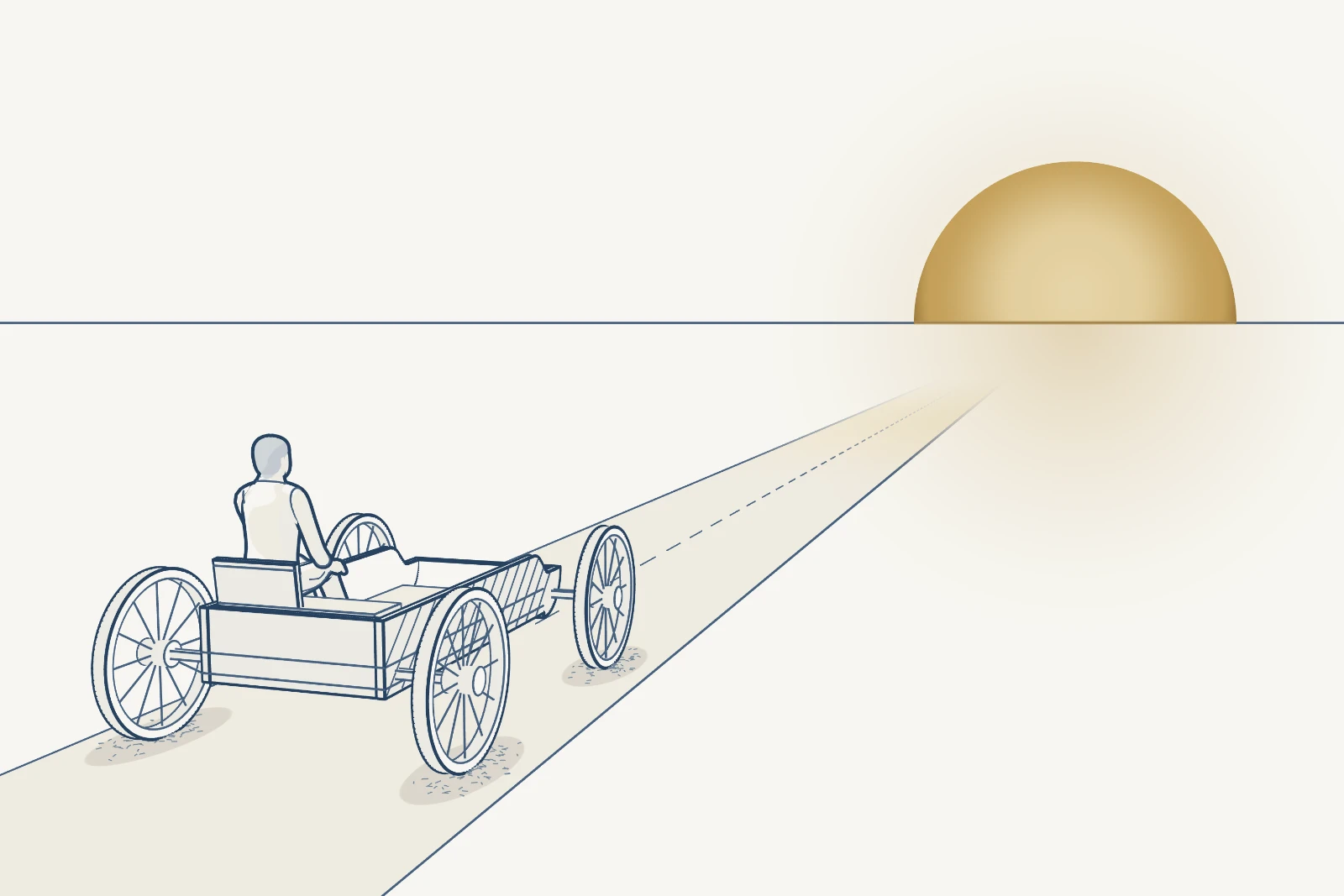
Welcome to Day 7. Seven days ago you sat down with a question and a vague sense that something in your inner life needed attention. Today you sit with something different—not yet the answer, but the beginning of a genuine relationship with that question. That is not a small thing.
Most people sense that something in their lives needs to change. Very few commit seven consecutive days to examining it honestly, practising every day, and returning each morning to the work. You have.
Today we are not going to cover new philosophical ground. Today we pause. We look back at what has been built. We understand where we stand. We see what comes next. And we quietly celebrate the fact that something genuine has begun.
Part I — Celebration
What has actually been built
Let me begin by telling you what you have actually built this week—not what you have merely heard, but what you have lived.
You have experienced the Journey of Life.
You examined the Traveller and discovered that you are not merely the body-mind complex you once assumed yourself to be, but the awareness that observes it. You also examined the Instrument—the body-mind complex through which the journey is made by the Traveller.
You examined the Goal and discovered that what you truly seek is not pleasure but peace—and beneath peace, the Bliss that is already present.
You examined the Path and discovered the Purusharthas—the Legitimate Human Endeavours—as the framework for a complete human life.
And finally, you examined the four wheels through which the Instrument engages with the world: relationships, work, finances, and values. That completes the 4.
You have also understood the 3—the Three Levels of Disturbance.
Disturbance can become visible at the Gross level, take the form of thoughts and emotions at the Subtle level, and become reinforced as conditioning at the Subconscious level. These levels interact, with deeper conditioning influencing subsequent thoughts, emotions and behaviour. You also discovered that the Instrument itself follows this same three-level architecture. That is why lasting transformation cannot come merely by changing external circumstances. It must come from within.
During the week we also explored something fascinating. The Pancha Skandha described in Buddhism and the Default Mode Network studied in modern neuroscience offer different perspectives on aspects of human experience. One emerges from centuries of contemplative inquiry; the other from empirical investigation of brain activity. Their points of connection are worth exploring, while recognising that the two frameworks are not equivalent.
And finally, you have been living the 5.
Every day you have engaged with Spiritual Orientation—the enquiry into who the Traveller truly is and is not.
Every day you have reflected on a Value drawn from the Indian wisdom traditions.
Every day you practised an Intentional Activity, drawn from Positive Psychology, showing through direct experience that the mind can be trained.
Every day you engaged with the Scientific Quadrant, giving intellectual understanding to what you were practising.
And every day you meditated—the central practice that works simultaneously at all three levels of the body-mind complex.
These are not five separate activities. They are one coordinated system.
The Journey of Life tells us what we are trying to govern. The Three Levels explain where disturbance arises and where transformation must occur. The Five Tools provide the practical means of bringing about that transformation. Together they form the architecture of The Life Manual. And for the past seven days, you have not merely been studying that architecture. You have been living it.
Perhaps the most important recognition of this week is this: The mind is not who you are. It is the most powerful instrument available to the Traveller. Like every instrument, it can remain untrained and reactive. Or it can be sharpened, refined and governed with increasing skill. That is the essence of Inner Governance, leading to Engaged Non-attachment (ENA).
Part II — The ENA milestone
Where this journey leads
Now let us look at the Seven Stages of Inner Governance. When you began on Day One, all seven stages lay ahead. Today, the first two stages have already begun taking shape.
Stage One—Understanding the Mind—is complete.
You have explored how the false sense of self is constructed. You have understood the Pancha Skandha. You have learnt how suffering is generated. You have examined the architecture of the Instrument and the Three Levels of Disturbance. Whether or not you realise it, you now understand the human mind more deeply than most people ever pause to examine.
Stage Two—Calming the Mind—is now underway.
The Purusharthas gave direction to your life. Karma Yoga began freeing action from anxiety about outcomes. Shama steadied the inner mind. Dama brought greater awareness to your engagement with the world. Bhramari and Thought Noting have already begun calming the deeper layers of the mind.
The change may not feel dramatic. But the Instrument may already feel a little steadier. Even if the change is not yet apparent, the foundations for further practice are being laid. Five stages still lie ahead. The journey is only beginning.
But before we look forward, I want to name clearly the destination toward which all of this is pointing. Throughout the week I have referred to it repeatedly. Today I want to state it fully. It is called Engaged Non-Attachment—ENA.
Inner Governance
“The disciplined capacity to regulate attention, emotion and behaviour even under pressure — in alignment with personal values and institutional ethos to fulfil the envisaged goal.”
Engaged Non-Attachment — ENA
The destination of Inner Governance is what TLM calls Engaged Non-Attachment, or ENA. ENA is the trained capacity to be fully present in every role you play, fully engaged in every responsibility, and fully committed in every relationship—without being defined, driven or destabilised by any one of them.
ENA is not
This is not indifference. It is not emotional withdrawal. It is not caring less.
Think of a great actor. While on stage, the actor gives everything to the performance. Every emotion is real. Every action is wholehearted. But when the curtain falls, the actor walks off the stage and is simply themselves. Not because they cared less. But because their identity was always deeper than the role they were playing.
The same principle applies to life. The leader at work is fully present while leading. The parent at home is fully present with the family. The student gives their very best in the examination hall without allowing the result to determine their self-worth. The homemaker serves the family with love and dedication without allowing that role to consume every other dimension of life.
It is caring deeply without becoming psychologically imprisoned by the role itself.
The Traveller knows who they truly are. And precisely because of that, they are able to participate more fully in every aspect of life. That is ENA. This is what seven days of practice have begun to cultivate. Not merely a pleasant feeling. The beginning of a new way of functioning. States slowly becoming traits. The work is real.
Part III — Honest reframing
What Week One was—and what it wasn’t
At this point, let me say something important.
A reflection
Week One was an introduction.
It was the unfolding of the map. You now understand the architecture of TLM. You have experienced each of its five tools. You have begun calming the mind. All of this is real. And all of it matters.
But deep conditioning is not dissolved in a single week. Long-established habits of reactivity do not disappear overnight. The subconscious patterns we have carried for years require sustained practice. That is exactly as it should be.
What you have done this week is begin the process through which states gradually become traits. Each day of practice has strengthened healthier neural pathways. Each meditation has reduced reactivity a little further. Each intentional activity has trained awareness. Each return to practice has quietly strengthened the governing capacity of the mind.
These changes may not yet feel dramatic. But they are genuine. And they are cumulative. That is why today’s value, Abhyasa (practice), is so appropriate.
Part IV — The week ahead
The Instruments
Now let us look ahead. Week One was called The Map. You now have that map.
Week Two is called The Instruments. And it takes us much deeper. During Week One we discovered that the Traveller is not the Instrument. But that does not make the Instrument less important. It makes it even more important. Every act of Inner Governance depends upon the condition of the Instrument through which it is exercised.
A chronically exhausted body cannot support a calm mind. A nervous system trapped in chronic stress cannot consistently produce wise decisions. Relationships become difficult. Values become harder to live. Attention becomes fragmented.
Week Two therefore focuses on strengthening the Instrument itself. We shall examine physical health with greater depth. Mental health. Stress. Attention. Resilience. Antifragility. The science of the body. The neuroscience of the mind. And the wisdom traditions that explored these realities thousands of years before modern science began measuring them.
Stage Two—Calming the Mind—continues. Stage Three—Training Attention and Focus—gradually comes into greater emphasis.
The meditation practices become more refined. The values become more specific. The Intentional Activities become more targeted. The Scientific Quadrant goes deeper.
The map is complete. Now the journey truly begins.
Value of the day
Abhyasa — sustained practice
The value that completes Week One is Abhyasa—sustained, patient practice.
Patanjali tells us that the fluctuations of the mind are quietened through practice and non-attachment. He also tells us what genuine practice looks like. It is sustained. It is uninterrupted. And it is undertaken with sincerity.
Not intensity. Not perfection. Continuity.
Modern neuroscience says exactly the same thing in a different language. Neuroplasticity occurs through repetition. One practice session produces a temporary state. Repeated practice gradually produces a lasting trait.
This is how the governing intellect becomes stronger. Not through one extraordinary effort. But through hundreds of ordinary ones.
Abhyasa protects us from three common traps.
- Impatience.
- Self-judgment.
- And the expectation of dramatic transformation.
Instead, it reminds us to return to practice—again and again—with steadiness and trust.
Value consistency over intensity. If you miss a day, simply begin again. Do not compare your journey with anyone else's. And never mistake quiet progress for the absence of progress.
Abhyasa is how calm gradually becomes stable clarity.
Intentional activity
Three Good Things
Today's Intentional Activity is called Three Good Things. It comes from the pioneering work of Martin Seligman and Positive Psychology.
Take five quiet minutes today. Identify three things from this past week that you genuinely appreciate. Not dramatic achievements. Not extraordinary experiences. Simply three real moments that mattered.
Perhaps you were slightly more patient than before. Perhaps one meditation felt deeper. Perhaps one conversation was calmer. Perhaps you noticed yourself pausing before reacting.
For each of these three things, write one simple sentence.
For each of your three things
What happened? Why did it matter?
The purpose of this exercise is not forced positivity. It is accurate recognition. Research consistently shows that consciously acknowledging genuine positive experiences increases wellbeing and reduces depressive thinking patterns.
It also reminds us that growth is often quiet. Before entering Week Two, pause long enough to recognise what has already begun. That recognition itself is an act of Viveka.
Good thing 2
Good thing 3
Scientific quadrant
Week One Integration
A note on the science
The Scientific Quadrant explains contemplative practices through current scientific understanding of psychology, behavioural science and neuroscience. The mechanisms described indicate how these practices may influence attention, emotional regulation, behaviour and wellbeing. Scientific understanding continues to evolve, and these explanations are not guarantees of specific outcomes. Individual experiences may vary.
What have we been training this week?
Over the past seven days, you have explored many ideas and practices:
- Self-awareness
- Viveka
- Yoga
- Purusharthas
- Shama
- Dama
- ENA
- Reflection
- Meditation
- Pranayama
At first glance these may appear to be separate teachings. But beneath them lies a single process.
Each practice repeatedly trains the brain to become:
- More aware
- Less reactive
- Better regulated
- More aligned with deeper values
Modern neuroscience calls this neuroplasticity—the brain's ability to change through repeated experience. Indian wisdom traditions call it Abhyasa—consistent practice. Different language. The same insight. Every practice you performed this week was helping transform momentary states into lasting traits.
The brain systems we have been training
Throughout Week 1, several major brain networks have been trained simultaneously.
Executive Control Network (ECN)
The Executive Control Network supports:
- Self-regulation
- Wise decision-making
- Delayed gratification
- Conscious choice
Every time you paused before reacting, practised Viveka, reflected on your actions or aligned yourself with Dharma, this network was being strengthened. This is the neurological foundation of Inner Governance.
Salience Network
The Salience Network helps determine: What deserves my attention right now?
Through:
- The Energy Audit
- Reflection exercises
- The Four Wheels
- The Three Levels of Disturbance
you learned to notice what truly matters rather than automatically reacting to whatever appears most urgent.
Default Mode Network (DMN)
The Default Mode Network generates many of the stories we tell ourselves:
- Who am I?
- What do I need?
- What is wrong with me?
- What will make me happy?
The teachings on identity, desire, attachment and suffering helped create awareness of these habitual narratives. Meditation helped create distance from them. Instead of being trapped inside every story, we gradually learn to observe them.
Attention Networks
Attention is one of the most trainable capacities of the human brain. Every meditation practice this week strengthened the ability to:
- Notice distractions
- Return attention
- Remain present
- Observe thoughts without immediately following them
This ability lies at the heart of both mindfulness and self-mastery.
Autonomic Nervous System
Through pranayama and meditation, the body repeatedly practised moving from stress and activation toward balance and recovery.
As nervous-system regulation improves:
- Emotional resilience increases
- Recovery improves
- Reactivity decreases
The body becomes a more supportive Instrument for the Traveller.
How Week 1 practices trained the brain
| Practice Category | Primary Brain Systems Trained | Likely Result |
|---|---|---|
| Spiritual Reflection | Default Mode Network & Executive Control Network | Greater self-awareness and clarity of identity |
| Values and Philosophy | Executive Control Network | Better decision-making and conscious choice |
| Intentional Activities | Salience Network & Executive Control Network | Improved alignment between priorities and actions |
| Pranayama Practices | Autonomic Nervous System | Reduced stress and improved emotional regulation |
| Meditation Practices | Attention Networks, DMN & Executive Control Network | Greater focus, awareness and mental steadiness |
Brain → Body → Behaviour
| Level | What Has Been Trained This Week? | What You May Already Notice |
|---|---|---|
| Brain | Stronger attention, greater self-awareness and improved self-regulation | More pauses between stimulus and response |
| Body | Better nervous-system balance and stress recovery | Greater calm, steadiness and energy |
| Behaviour | More conscious choices and reduced impulsive reactions | Better alignment between intentions and actions |
Why repetition matters
A single meditation session rarely transforms a life. A single insight rarely removes suffering. A single act of self-awareness rarely changes long-standing habits. Transformation occurs through repetition.
Every time a neural pathway is used, it becomes slightly stronger. Every time a reaction is interrupted, a new possibility emerges. Every time awareness replaces automaticity, the brain learns a different way of operating.
This is why all wisdom traditions emphasise practice. Change does not occur because we understand an idea. Change occurs because we repeatedly embody it.
Scientific takeaway for Week 1
Week 1 was not about collecting ideas. It was about beginning the training of a new way of being.
The Traveller has begun to understand:
- Who they are.
- What they seek.
- The path they wish to follow.
- The Instrument they must care for.
- The wheels through which life unfolds.
- The tools available for transformation.
Through repeated practice, these insights gradually move from intellectual understanding to lived experience. This is how temporary states become lasting traits. This is how knowledge becomes wisdom. And this is how Inner Governance begins.
Day 7 in brief
- Week One introduced the TLM framework and its five tools.
- ENA describes wholehearted engagement without being defined by a role.
- Abhyasa asks for sustained, patient practice.
- Three Good Things makes space to recognise real moments of progress.
- Week Two turns towards strengthening the Instrument.
Part V — A reference for the journey
The origins of what you have been practising
Before we move forward, I would like to show you one final reference. Throughout this week you have encountered values from the Indian wisdom traditions, intentional activities drawn from Positive Psychology, breathing practices from Yoga, meditations from Buddhist and Yogic traditions, and scientific explanations from contemporary neuroscience. This Origins Chart shows where each of these practices comes from. Think of it as your recommended reading and reference guide.
You do not need to study it now. Simply know that it is available whenever you wish to explore any of these practices in greater depth.
TLM is not built upon the ideas of a single person. It is built upon humanity's accumulated understanding of the human mind, carefully synthesised into one practical framework for daily living.
Week 1 Origins Chart
| Values | |
|---|---|
| Practice | Origin, source and authority |
| Viveka — Discernment | Upanishads (primary source) Advaita Vedanta tradition Vivekachudamani of Shankaracharya, 8th century CE |
| Vairagya — Non-Clinging | Vedanta and Yoga Yoga Sutras of Patanjali, ~400 CE |
| Tapas — Inner Discipline | Yoga, Buddhism, Jainism, Sikhism Universal across traditions |
| Karma Yoga — Right Action | Bhagavad Gita Chapters 3 and 6 |
| Shama — Steadiness of Mind | Upanishads (primary source) Shat-Sampat Vivekachudamani of Shankaracharya |
| Dama — Governance of Outward Engagement | Upanishads (primary source) Shat-Sampat Companion to Shama |
| Abhyasa — Sustained Practice | Bhagavad Gita Chapter 6 Yoga Sutras of Patanjali, Sutras I.12-14 |
| Intentional activities | |
|---|---|
| Practice | Origin, source and authority |
| Day 1 — Sensory Awareness Practice | MBSR Jon Kabat-Zinn, University of Massachusetts, 1979 |
| Day 2 — Finding the Gap | Vipassana tradition MBSR Theravada Buddhism |
| Day 3 — Pause, Breathe, Choose | MBSR Positive Psychology Kabat-Zinn / Seligman |
| Day 4 — Values-Based Action | Positive Psychology Emotion regulation research Gross, 1998 |
| Day 5 — Energy Audit | Positive Psychology Loehr and Schwartz, The Power of Full Engagement |
| Day 6 — Wheel of Life Reflection | Positive Psychology Paul Whitmore Evidence-based coaching |
| Day 7 — Three Good Things | Positive Psychology Martin Seligman, University of Pennsylvania Kristin Neff self-compassion research |
| Pranayamas | |
|---|---|
| Practice | Origin, source and authority |
| Days 1-2 — Yogic Breathing (diaphragmatic) | Classical Yoga Hatha Pradipika May support autonomic regulation and stress reduction. |
| Days 3-4 — Nadi Shodhana (1:1:1 then 1:1:2) | Hatha Yoga Hatha Pradipika Some studies suggest effects on relaxation and cardiovascular measures; findings remain preliminary. |
| Days 5-7 — Bhramari (humming breath) | Hatha Yoga Hatha Pradipika Preliminary studies suggest possible calming and autonomic effects; stronger research is needed. |
| Meditations | |
|---|---|
| Practice | Origin, source and authority |
| Day 1 — Mantra Meditation (So-Hum) | Patanjali Yoga Sutras Sutra I.28 Japa tradition |
| Day 2 — Relaxation Response | Harvard Medical School Dr Herbert Benson, 1975 |
| Days 3-4 — Belly-Focused Mindfulness | MBSR Jon Kabat-Zinn, 1979 Theravada Buddhism Zen tradition (hara awareness) |
| Day 5 — Ānāpānasati (nostril awareness) | Theravada Buddhism Majjhima Nikaya Mahasi Sayadaw |
| Day 6 — Thought Noting | Vipassana Theravada Buddhism Mahasi Sayadaw, 20th century |
| Day 7 — Integration Meditation | Synthesis: Yoga, MBSR, Vipassana Week 1 consolidation |
Closing
The invitation into Week Two
Seven days ago I invited you to take one deliberate step. You took it. And then six more.
You have built the map. You have begun calming the Instrument. You have experienced the five tools of Inner Governance working together. You now understand where disturbance arises. You also understand where genuine transformation begins.
Most importantly, you have begun moving towards Engaged Non-Attachment—not merely as an inspiring idea, but as a way of living.
Tomorrow we begin Week Two. The Instruments. The work becomes deeper. The practices become more refined. The understanding becomes more stable.
Carry one thing with you from this first week. Recognise that something has genuinely shifted. Perhaps quietly. Perhaps subtly. But genuinely. That is now yours. And it is the foundation upon which everything else will be built.
Pranayama — Bhramari Pranayama
Meditation — Integration Meditation
Guided audio — 15 minutes
Meditation — Integration Meditation
Guided audio — 15 minutes
Press play on the meditation audio, sit comfortably, and simply practise.
Your meditation is waiting. Press play. Welcome to Week Two.
Use the course meditation recording for the guided practice. The timer below is a quiet companion for practising on your own.
Day 7 — Reflection
Notes for the Traveller
Return to one moment, one role and one steady intention.
Which moment from this week helped you notice a difference between the Traveller and the Instrument?
Which role could you enter wholeheartedly while holding its outcome more lightly?
What will help you return to practice with steadiness as Week Two begins?