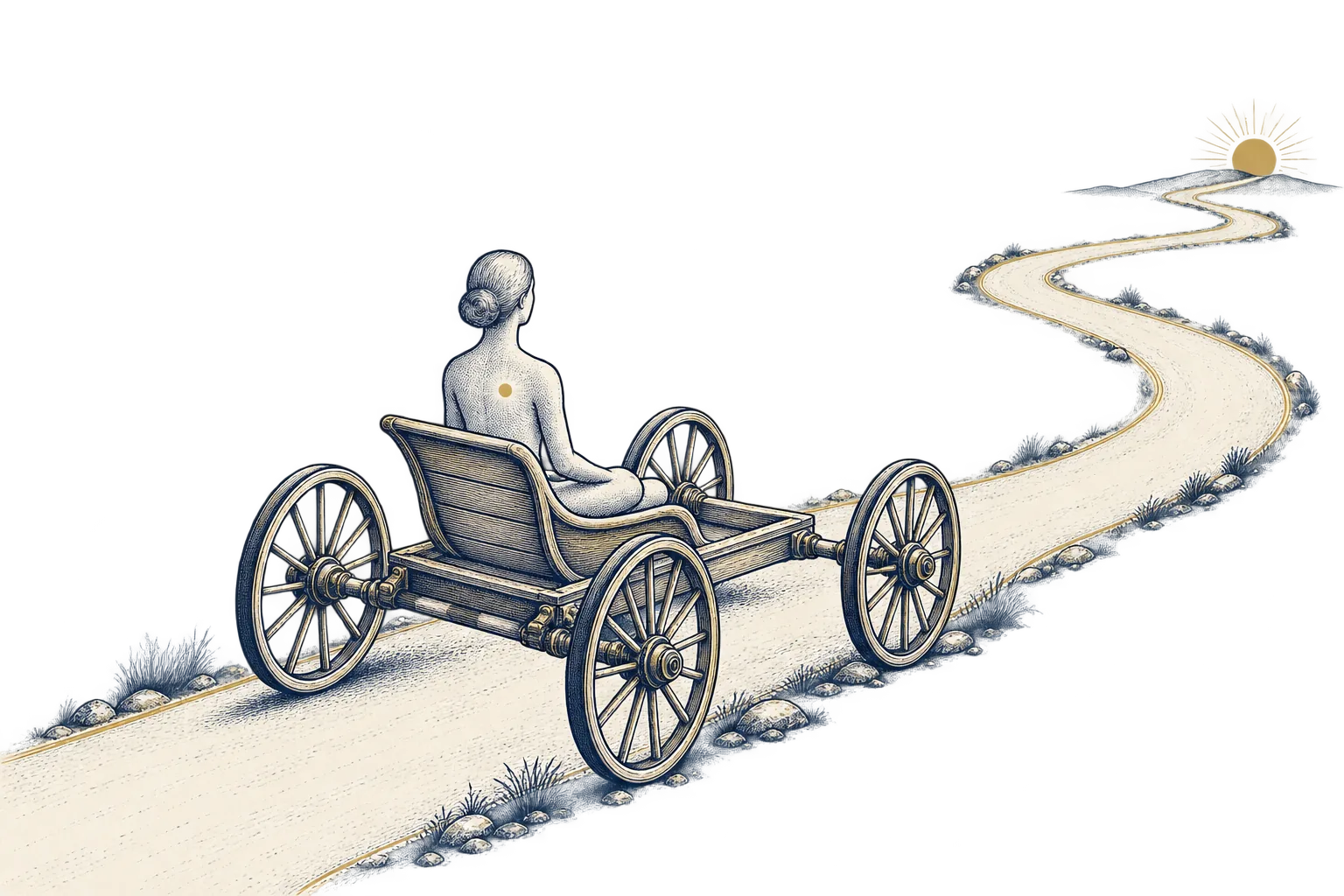
Welcome to Day 6
Engage fully with life, guided by what truly matters.
Read how the four wheels of life connect with the three levels of disturbance and the five TLM tools. Use the Wheel of Life Reflection to notice where a small action could help, then continue with the meditation audio and your notes.
The shape of today
- The four wheelsSee where everyday life calls for attention.
- The three levelsUnderstand disturbance within the Instrument.
- The five toolsRecognise the coordinated TLM framework.
- DamaBring conscious choice into outward engagement.
- The Wheel of Life ReflectionChoose one small action in a strained domain.
- Science, meditation and reflectionConnect the teaching with continuing practice.
Life can get busy. Take more than 21 days if you need to; there is no need to rush. If you cannot move to the next day of TLM Basic, continue practising the Value of the Day, Intentional Activity and Meditation from the last day you completed. When you are ready, resume the programme from where you left off.
The Instrument meets the terrain
Welcome back.
Yesterday we learnt to care for the Instrument—the body-mind complex that the Traveller uses to transact the business of life while travelling on the four-wheeled Vehicle towards his Goal. We explored the importance of movement, nutrition, sleep, and the cultivation of a steady and resilient mind.
But the Instrument is not built to stand still. It exists to move, to engage, and to act. And the Vehicle of life moves on four wheels.
Today we examine the four wheels on which the Vehicle of every human life travels through the world: Profession and Work, Finances, Relationships, and Values and Ethics. These are the four domains through which the Traveller engages with life every single day.
Today also completes the conceptual map of Week One. By the end of this module, every major element of the TLM framework will be in place. Tomorrow we will step back and integrate everything we have learnt. But today—we complete the map.
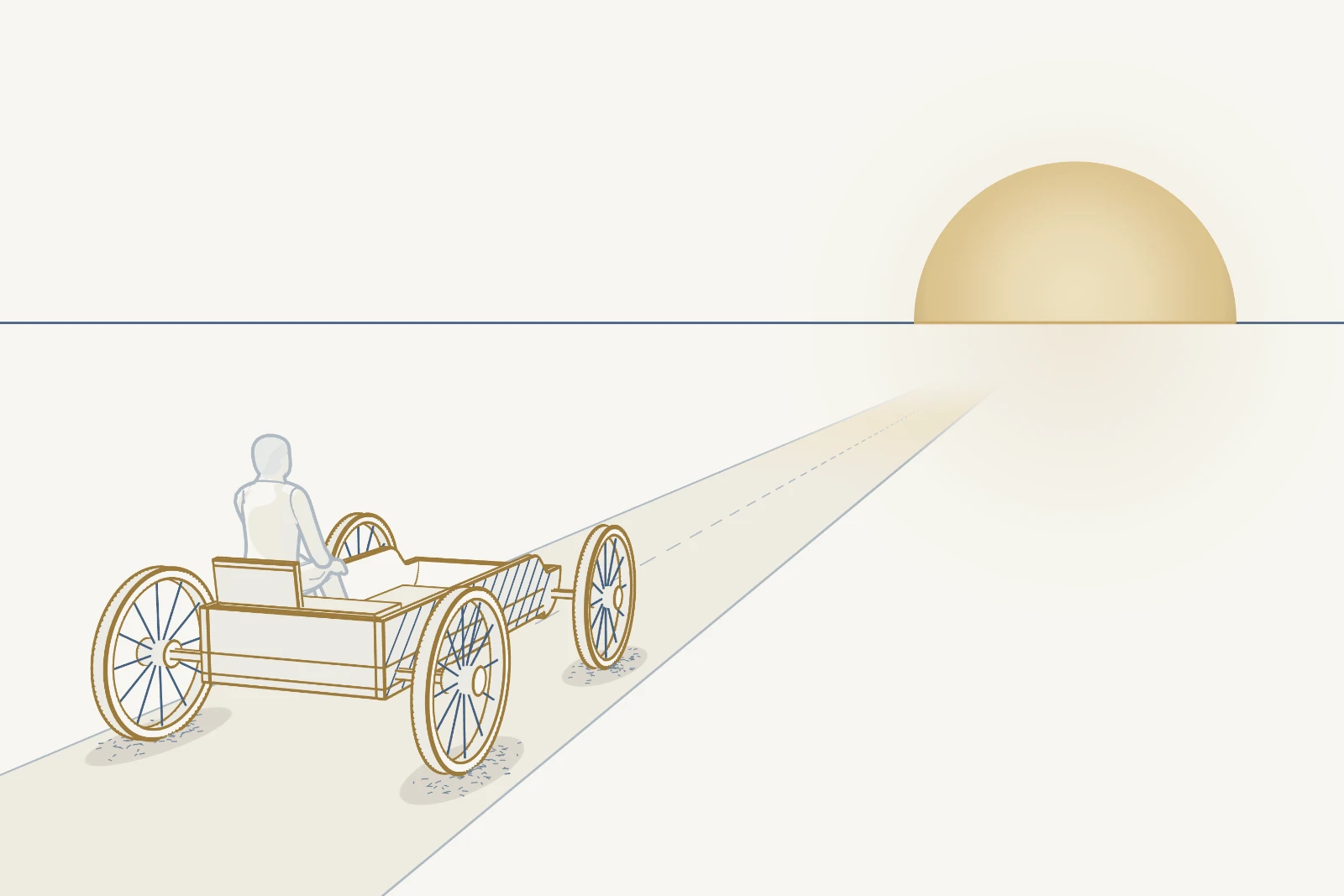
The four wheels: where the Vehicle meets the world
Modern stress may appear modern, but it is not. Across cultures and across centuries, human difficulty has consistently centred around the same four domains of life. The circumstances change. The technologies change. But these four wheels remain remarkably constant.
Wheel 1 — Relationships
Most suffering in relationships does not arise primarily because of other people. It arises from within—from unspoken expectations, the craving for validation, and the fear of rejection or loss.
When these expectations remain unconscious, we stop seeing people as they truly are. Instead, we begin relating to the roles we have silently assigned them.
Research consistently confirms what the wisdom traditions have always taught. The quality of our close relationships is one of the strongest predictors of long-term wellbeing and even physical health.
Not the number of relationships. The quality. And that quality depends not only on the other person, but on the awareness, honesty and non-attachment we bring into the relationship.
Compassion—genuine, non-transactional concern for another person's wellbeing—is what stabilises relationships when expectation and fear would otherwise corrode them.
Wheel 2 — Profession and Work
For most adults, work occupies more waking hours than any other activity.
This is true not only of paid or self-employed professionals. A homemaker managing a household and raising children carries responsibilities no less demanding than many executives. For students, this wheel has already begun turning through studies, examinations and career aspirations.
Across all these situations, one pattern remains remarkably consistent. Suffering begins when identity becomes fused with performance. When success means I am valuable, and failure means I am not, every setback becomes a threat to identity itself.
Anxiety increases. Comparison becomes habitual. The fear of failure grows larger than the work itself. This is the same misidentification we examined on Days One and Two, now operating through the professional wheel.
When work is seen as a function rather than an identity—as one important dimension of life rather than its definition—pressure reduces. Decisions become clearer. Effort becomes the natural expression of Karma Yoga—right action performed without compulsive attachment to outcomes.
Wheel 3 — Finances
Money, in itself, is neutral. Stress does not arise from money. It arises from our psychological relationship with money—from the fear of not having enough, compulsive accumulation, endless comparison, or guilt.
As we discussed on Day Four, Artha is one of the four legitimate human pursuits because material security is a genuine requirement for a complete human life.
The financial wheel must be maintained. The mistake occurs when the wheel becomes the destination.
When financial security is mistaken for the Goal itself instead of recognising it as one aspect of the financial wheel supporting the journey.
The wisdom traditions repeatedly caution us against psychological possessiveness.
- Patanjali speaks of Aparigraha (non-possessiveness).
- Buddhism speaks of Upadana, or clinging.
- Sikhism warns against Lobh, greed.
- Jainism elevates Aparigraha into one of its central ethical principles.
- The Bhagavad Gita teaches Nishkama Karma.
Different traditions. One shared insight. It is not money that creates suffering. It is our attachment to it.
When we understand clearly what money is for—and what it is not—the financial wheel becomes far steadier.
Wheel 4 — Values and Ethics
The fourth wheel is perhaps the least examined, yet one of the most important. When our values are unclear, decisions become unnecessarily heavy. Small compromises accumulate. Inner conflict grows, often without us fully understanding why.
But when values are clear—when Dharma is understood and consciously lived—even difficult decisions become simpler. The choices may still be demanding. But the framework for making them is stable. A well-aligned ethical wheel reduces friction across every other domain of life.
The four wheels explain where life's challenges arise. The next question is: why do some challenges become suffering while others become opportunities for growth?
The three levels: how the wheels generate disturbance
Now let us connect today's discussion with something we introduced earlier—the Three Levels of Disturbance. The Gross, Subtle and Subconscious levels are not merely a model of how suffering develops. They are also the internal architecture of the Instrument itself.
The body operates at the Gross level.
The mind—our thoughts, emotions and attention—functions at the Subtle level.
And our deepest conditioning and identity-based misidentification reside at the Subconscious level.
The Amritabindu Upanishad states it beautifully:
"The mind alone is the cause of bondage and liberation."
The four wheels certainly generate challenges. Relationships. Work. Money. Ethical dilemmas. But these are the terrain. Whether they become suffering depends on how the Instrument responds.
When any wheel generates pressure—a difficult conversation, a professional setback, financial anxiety or an ethical compromise—the disturbance first appears in our behaviour. But its roots lie deeper.
Thoughts and emotions begin reacting. If these reactions continue automatically, they gradually become conditioning. The pattern deepens.
This explains why solutions aimed only at external circumstances often produce temporary relief.
- Financial advice helps.
- Relationship counselling helps.
- Career coaching helps.
- Ethics training helps.
But unless the deeper patterns of the mind also change, the same disturbances eventually return.
TLM therefore works simultaneously at all three levels. That is the 3 in the 4-3-5 framework. And it does so through five coordinated tools. Which brings us to the final piece of today's framework.
The five tools: what you have been doing this week
By now you have been using all five tools of TLM every single day. Perhaps without fully recognising them as one integrated system.
Every day you have engaged with Spiritual Orientation—the enquiry into who the Traveller truly is, and the recognition that we are not merely the body-mind complex we usually assume ourselves to be.
Every day you have engaged with Philosophical Orientation through values drawn from the Indian wisdom traditions—Viveka, Vairagya, Tapas, Karma Yoga, Shama and Dama—each helping reshape conduct and character.
Every day you have practised an Intentional Activity, drawn from positive psychology, demonstrating through direct experience that the mind is trainable and that small, deliberate actions accumulate into lasting change.
Every day you have engaged with the Scientific Quadrant, providing the intellectual understanding that supports practice. Without understanding, practice becomes mechanical. With understanding, change becomes conscious and deliberate.
And every day you have meditated—the central tool that works simultaneously across all three levels of the body-mind complex, calming behaviour, refining thought and gradually transforming deep conditioning.
These are not five separate activities. They are one coordinated system. Each strengthens the others. Each works at a different depth. Together they address the entire architecture of the body-mind complex.
That is the 5 in the 4-3-5 framework. And you have already been living it—one day at a time.
Dama — governance of outward engagement
The value for Day Six is Dama, drawn from Advaita Vedanta. It naturally completes the journey we began yesterday with Shama.
Shama is the steadiness of the inner mind. Dama is the conscious governance of our outward engagement with the world. Together they form the first two disciplines of the Shat-Sampat, the six inner treasures described in Advaita Vedanta.
Shama steadies the inner mind. Dama governs the direction in which the Instrument engages with life.
Applied to the four wheels, Dama becomes very practical.
- How consciously do we nurture our relationships?
- What truly drives our professional choices—clarity or compulsion?
- Are our financial decisions guided by genuine need and values, or by fear and comparison?
- Are our ethical choices based on carefully examined principles, or simply on convenience?
Dama does not mean withdrawing from life. It does not mean suppressing desires or abandoning responsibility. It means engaging consciously rather than automatically.
The charioteer continues to guide the horses. He does not abandon the reins. Dama is the capacity to notice when perception begins triggering automatic reactions—and to pause before habit takes over.
Not in meditation alone. But in conversations. Professional decisions. Financial choices. Ethical dilemmas.
Practise three simple things today.
- Engage consciously with each of the four wheels.
- Notice whenever one wheel begins pulling the Vehicle off course.
- And bring the same awareness to your outward engagement that Shama brings to your inner life.
Together, Shama and Dama make Inner Governance visible in daily living.
The Wheel of Life Reflection
Today's Intentional Activity is called the Wheel of Life Reflection. Drawn from Positive Psychology and widely used in coaching, it mirrors today's four-wheel framework and takes only about five minutes.
On Day 1 you recorded your baseline: a score from 1 to 10 for each of the four domains—Relationships, Profession and Work, Finances, and Values and Ethics. Today, at the end of Week 1, is the first reassessment. Rate the same four domains on the same 1–10 scale, then compare your current scores with Day 1. Scores need not rise; the purpose is to notice where each wheel stands today.
Your Wheel of Life
Record your scores from 1 to 10. Your entries are saved in this browser and gathered in your notebook.
Your earlier checkpoints
A dash means no score has been saved here.
The lowest score identifies the wheel creating the greatest strain in your life today.
Now identify one small, specific action—not a major life overhaul—that could improve that wheel even slightly. Write it down. Then do it.
This exercise is Dama in practice. Repeat it again on Days 14 and 21. Compare today's numbers with your Day 1 baseline. The changes you observe over the coming weeks will become evidence of your own growth.
From automatic reaction to conscious engagement
The Scientific Quadrant explains contemplative practices through current scientific understanding of psychology, behavioural science and neuroscience. The mechanisms described indicate how these practices may influence attention, emotional regulation, behaviour and wellbeing. Scientific understanding continues to evolve, and these explanations are not guarantees of specific outcomes. Individual experiences may vary.
Today we continue Stage Two—Calming the Mind.
What are we training today?
Today's teaching expanded the map of Inner Governance. We explored the Four Wheels of Life—Relationships, Work, Finances, and Values & Ethics. We examined the Three Levels of Disturbance—Gross, Subtle and Subconscious. And we revisited the Five Tools of Transformation that TLM uses to create lasting change.
At first glance these may appear to be different ideas. However, they all train a single human capacity: The ability to engage with life consciously rather than react automatically.
Most people spend much of their lives reacting. A difficult conversation triggers anger. A financial setback triggers anxiety. A criticism triggers defensiveness. A desire triggers impulsive action. The reaction often feels automatic.
Modern neuroscience suggests that this happens because deeply conditioned neural pathways operate faster than conscious awareness.
The purpose of today's practices is not to suppress life, avoid life, or withdraw from life. It is to engage with life more consciously. This is the essence of Dama.
Today’s brain systems
Salience Network
The Salience Network acts as the brain's prioritisation system.
It constantly evaluates:
- What is important?
- What deserves attention?
- What requires action?
Every day, the Four Wheels compete for attention. Relationships demand attention. Work demands attention. Finances demand attention. Values demand attention.
A well-trained Salience Network helps us recognise what truly matters rather than being pulled by whatever is loudest or most urgent.
Executive Control Network (ECN)
The Executive Control Network helps us pause, evaluate and choose our response.
This network allows us to:
- Delay impulsive reactions
- Consider consequences
- Align actions with values
- Stay committed to long-term goals
This is the modern neurological equivalent of consciously holding the reins rather than allowing the horses to run wherever they wish. Dama strengthens this capacity.
Default Mode Network (DMN)
The Default Mode Network creates and maintains our personal narrative.
It continuously generates thoughts such as:
- "I am successful."
- "I am a failure."
- "People don't appreciate me."
- "I need more to be happy."
Many disturbances at the subtle and subconscious levels arise not from events themselves, but from the stories we construct around them.
Today's teachings help us observe these narratives rather than becoming trapped within them.
Attention Networks
The brain's attention systems determine where awareness is placed. Thought Noting Meditation directly trains these networks.
Instead of becoming lost in every thought, we learn to notice:
Thinking is happening.
Without immediately following the thought stream. Over time, this creates greater mental freedom and choice.
How today’s practices train the brain
| Practice | Brain System Trained | Likely Result |
|---|---|---|
| Reflection on the Four Wheels | Salience Network | Better prioritisation and greater awareness of neglected life domains |
| Reflection on the Three Levels of Disturbance | Default Mode Network & Self-Awareness Systems | Increased recognition of hidden mental patterns and conditioning |
| Dama (Wise Regulation of Engagement) | Executive Control Network | Greater ability to choose responses consciously rather than react impulsively |
| Intentional Activity: Wheel of Life Reflection | Salience Network & Executive Control Network | Improved alignment between attention, priorities and daily action |
| Bhramari Pranayama | Autonomic Nervous System & Emotional Regulation Systems | Reduced emotional reactivity and increased calm |
| Thought Noting Meditation | Attention Networks & Executive Control Network | Improved ability to observe thoughts without becoming entangled in them |
Brain → Body → Behaviour
| Level | What Changes Through Practice? | What You May Notice in Daily Life |
|---|---|---|
| Brain | Stronger attentional control, better prioritisation and improved self-regulation | Greater clarity when deciding what deserves your time and energy |
| Body | Reduced stress activation and improved nervous-system balance | More steadiness during challenging situations |
| Behaviour | Less impulsive reacting and more intentional responding | Better relationships, wiser decisions and greater consistency with personal values |
Why repetition matters
Every time you pause before reacting, you strengthen neural pathways associated with conscious choice.
Every time you notice a thought without automatically believing it, you strengthen awareness.
Every time you align your actions with your values rather than your impulses, the brain becomes more efficient at self-regulation.
This is how Dama develops. Not through a single insight. But through repeated moments of conscious engagement.
Over time, what initially requires effort gradually becomes a natural way of living.
Day 6 scientific takeaway
Life does not become easier when we control every circumstance. Life becomes easier when we learn to engage with circumstances consciously.
The Four Wheels remind us where life's challenges arise. The Three Levels reveal how those challenges become suffering. The Five Tools provide practical methods for transformation.
Together, today's practices train the brain to move from automatic reaction toward conscious engagement. This shift—from reacting to responding—is one of the most important capacities in Inner Governance.
The map is ready for integration
Six days ago you began with one simple question: Who am I, really?
Since then you have explored the Traveller. You have discovered the Goal. You have understood the Path. You have learnt to care for the Instrument. And today you have examined the four wheels through which the Instrument moves through life. The 4 of the 4-3-5 framework is now complete.
You have also understood the 3—the three levels at which disturbance develops. And, perhaps without realising it, you have been practising the 5—the five coordinated tools that work together to transform the entire body-mind complex.
The purpose of the 4-3-5 framework is to develop and strengthen Inner Governance—the ability to govern our thoughts, emotions, impulses, habits and actions through awareness, wisdom and self-regulation.
As Inner Governance grows, we become better equipped to participate fully in life without being controlled by our attachments. This is the foundation of Engaged Non-Attachment (ENA).
All of this prepares us for one central idea. Engaged Non-Attachment—ENA. The ability to participate fully in every role, every responsibility and every relationship—without allowing any one of them to define who we truly are.
Engaged Non-Attachment, in turn, opens the way to human flourishing—the larger outcome towards which the whole programme is directed.
Tomorrow is not a day of new ideas. It is a day of integration. A day to recognise how all these pieces fit together, and to prepare for the deeper journey that lies ahead in Weeks Two and Three.
Your meditation is waiting. Six days completed. Fifteen remain. Press play.
Guided meditation
Meditation — Thought Noting
Guided audio — 15 minutes
Press play on the meditation audio, sit comfortably, and simply practise.
Use the course meditation recording for the guided practice. The timer below is a quiet companion for practising on your own.
Notes for the Traveller
A little space to notice what the day has shown you.
Which wheel felt most strained today, and what small action did I choose?
Where did I pause before habit took over and engage more consciously?
What thought or personal story did I notice without immediately following it?