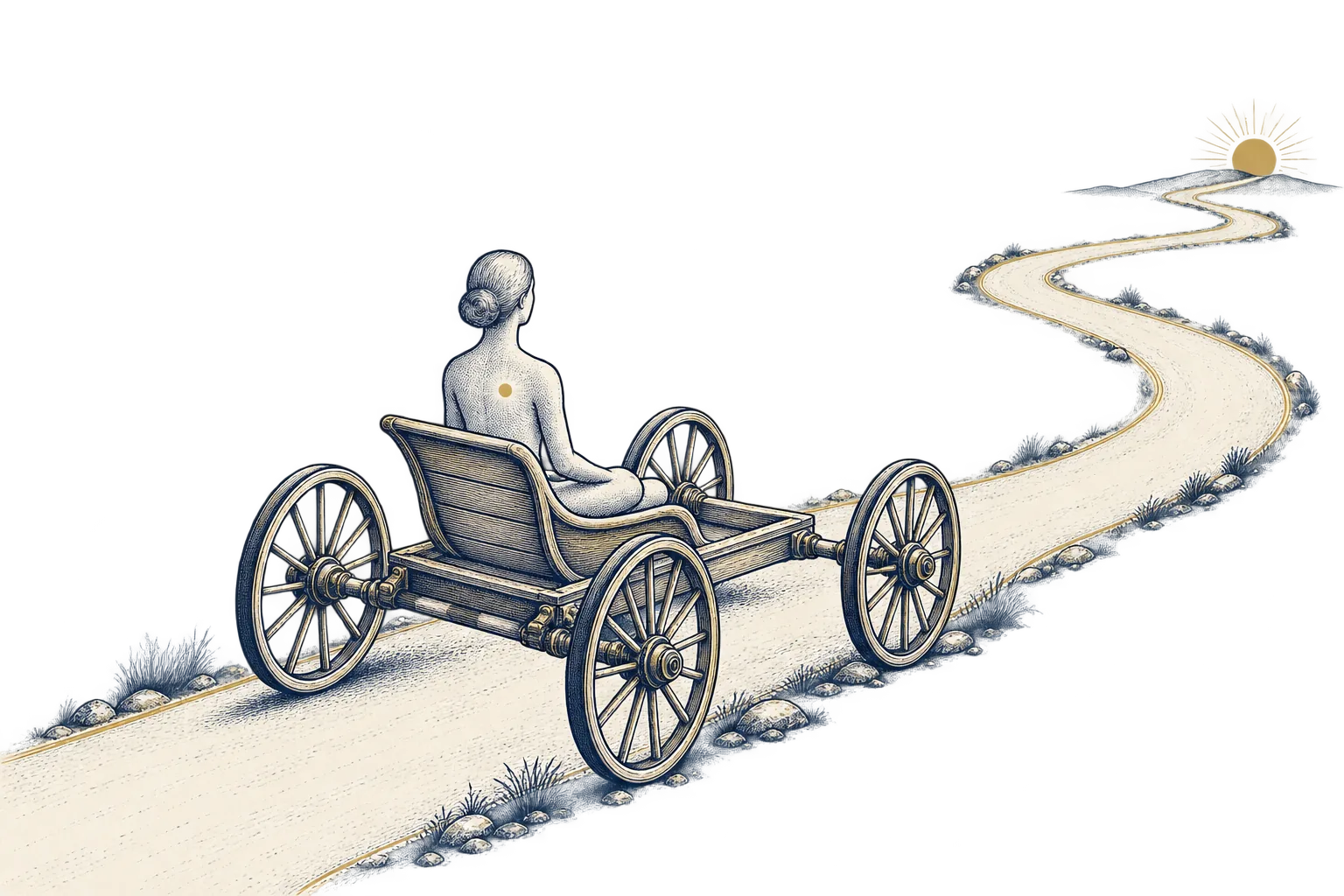
Welcome to Day 5
Care for the instrument through which you live, act and grow.
Read how the body, senses, mind and intellect serve the Traveller. Carry the Energy Audit into your day, then use the meditation audio and reflection prompts to notice how you are caring for your Instrument.
The shape of today
- The complete chariotUnderstand the body, senses, mind, intellect and Traveller.
- Care for the InstrumentMovement, food, sleep and mental hygiene.
- ShamaCultivate steadiness of mind.
- The Energy AuditNotice your condition in three brief pauses.
- The scientific quadrantConnect the teaching with the body-brain system.
- Meditation and reflectionContinue with the audio and make a few notes.
Life can get busy. Take more than 21 days if you need to; there is no need to rush. If you cannot move to the next day of TLM Basic, continue practising the Value of the Day, Intentional Activity and Meditation from the last day you completed. When you are ready, resume the programme from where you left off.
From the Path to the Instrument
Welcome back. Today we explore one of the most vivid and practically useful metaphors any tradition has produced for understanding the body-mind complex.
Over the last four days, we have worked with the Journey of Life map. We examined the Traveller and discovered that we are not the body-mind complex we usually take ourselves to be, but the awareness that observes it. We explored the Goal and found that what we truly seek is not pleasure but peace—and beneath peace, Bliss. We then examined the Path and discovered the Purusharthas—the Legitimate Human Endeavours—as the framework for living a complete human life.
Today we turn to the Instrument—the body-mind complex through which the Traveller engages with every aspect of the journey. Before we can master the journey, we must learn to understand, maintain and train the Instrument through which the journey is made.
The Katha Upanishad calls it the Chariot. In TLM, we shall simply call it the Instrument—a word that captures both its nature and its function. The body, the senses, the mind and the intellect—galvanised by the Self, the Traveller—together form the Instrument through which we live, act and move along the Path.
The Instrument is not who the Traveller is. But without it, the journey cannot be made. And any instrument that is neglected, strained or poorly maintained makes even the clearest path difficult to travel.
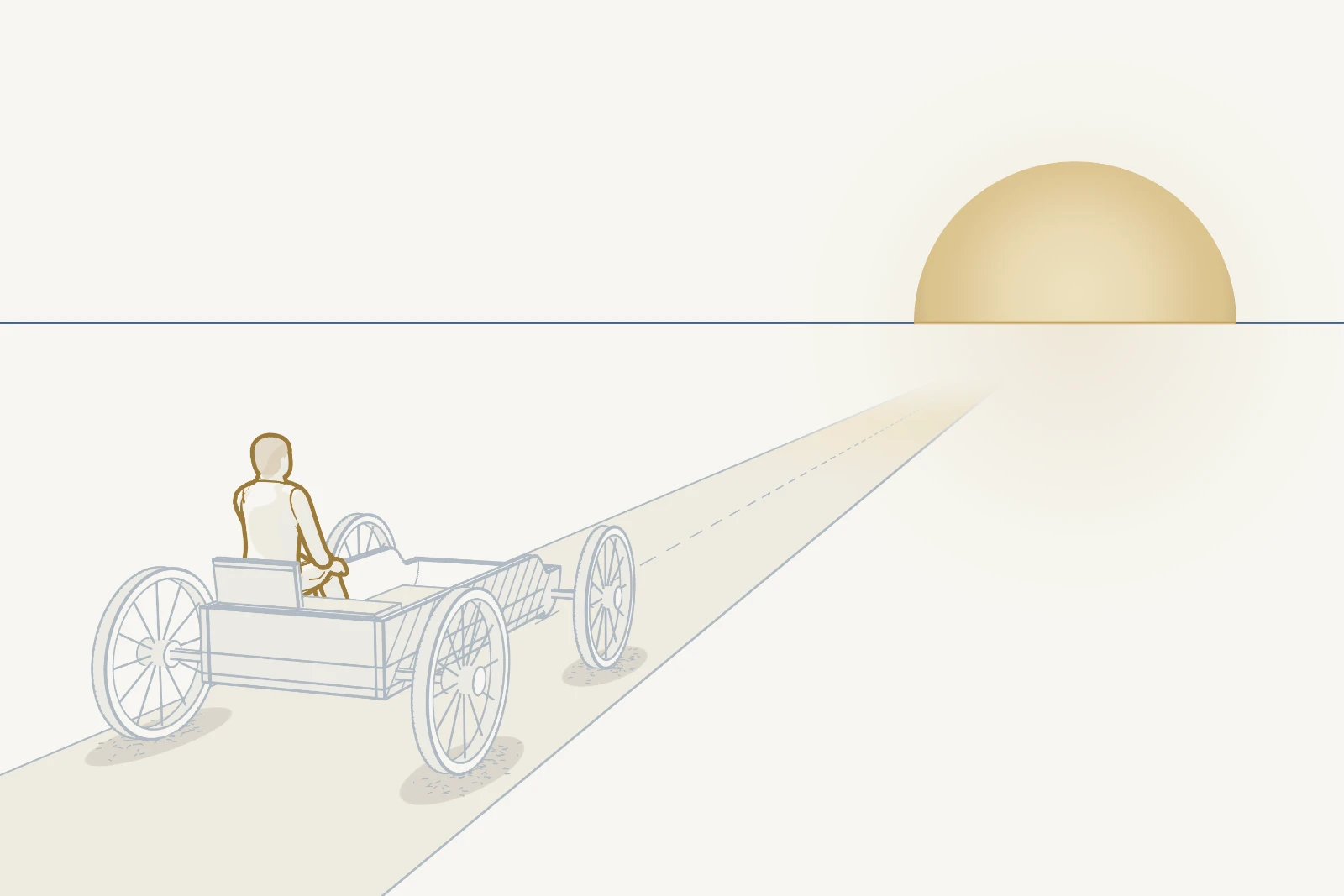
The Katha Upanishad: the complete chariot
The Katha Upanishad gives us an image that is nearly three thousand years old, yet it describes the human condition with remarkable precision. Picture a chariot on a long journey. There is a destination ahead. But the question that determines everything is not simply how good the road is—it is whether the chariot and its master are fit to travel it.
The body is the chariot itself—the physical vehicle that carries everything.
The senses are the horses, each naturally drawn towards its own objects—sound, sight, smell, taste and touch. Left ungoverned, they pull in different directions, and the chariot veers off course regardless of how clear the destination may be.
The mind is the reins. Through the reins the energy of the horses is guided. Slack reins mean the horses go wherever they please. Too tight reins mean that the horses might refuse to go any further. Steady reins allow them to move together with purpose.
The intellect is the charioteer. It exercises judgment, makes decisions and determines the direction of travel. A clear intellect guides wisely. A clouded intellect, confused by conditioning and emotional reactivity, struggles even when holding the reins.
And seated within the chariot is the Self—the true master, the Traveller. Not the charioteer, the intellect. Not the reins, the mind. Not the horses, the sense organs. The one for whose journey the entire apparatus exists.
When the Self forgets its true nature and begins identifying with the chariot, the horses or the reins, the journey loses its direction. This is the same misidentification we explored during the first two days.
This, then, is the complete Chariot—body, senses, mind and intellect, with the Self as the true master. This is also what TLM means by the body-mind complex. Not merely the physical body, or the mind, but the complete instrument through which we experience, think, decide and act.
The Instrument is not the same as the four wheels on which it travels. The Instrument is the body-mind complex itself. The four wheels—our work, finances, relationships and values—are the domains through which the Instrument engages with life. Today we care for the Instrument. Tomorrow we shall examine the wheels.
The tradition summarises the importance of the Instrument beautifully:
"Sharira-madhyam khalu dharma-sadhanam." The body is the primary instrument of Dharma.
Notice the emphasis. Not the goal of life. The instrument.
We care for it not because we are the body—we have already established that we are not—but because the journey requires a steady Instrument.
- A restless body disturbs attention.
- An agitated mind obscures clarity.
- A fatigued intellect makes poor decisions.
- Unrestrained senses take us on the wrong path.
The Self remains untouched by all of this—but until the Traveller fully recognises that truth, every disturbance of the Instrument is experienced as one's own.
The three foundations of physical care
If the Instrument is to serve the Traveller well, it must be cared for.
The first foundation is movement.
The body was designed for movement. Every great health tradition—and modern exercise science—agrees that regular physical movement is essential for maintaining both physical vitality and mental balance. Movement helps regulate the nervous system, reduces accumulated stress, improves mood and sharpens attention.
The form matters less than the consistency. Walk, swim, practise yoga, run—choose whatever you can sustain. A moderate daily practice is far more valuable than occasional bursts of intense effort.
The second foundation is food.
The Chandogya Upanishad observed long ago:
"When food is pure, the mind becomes clear."
Today, science confirms that what we eat directly influences our energy, mood, attention and sleep.
The emphasis is not on rigid rules. It is on awareness. Begin noticing how different foods affect your energy, your emotions and your clarity of mind. That awareness itself becomes part of caring for the Instrument.
The third foundation is sleep.
Sleep is perhaps the most neglected of these foundations, yet it is the one on which all the others depend.
During sleep the brain consolidates learning, regulates emotions, clears metabolic waste and restores the prefrontal cortex—the brain's charioteer—to full effectiveness.
Without adequate sleep, meditation becomes harder, emotional reactivity increases, attention weakens and good decisions become more difficult.
Sleep is not an indulgence. It is the nightly restoration of the Instrument. A rested charioteer holds the reins well. A fatigued one cannot.
Stress, resilience and mental hygiene
The physical body is only one part of the Instrument. The other—and in many ways the more critical part for Inner Governance—is the mind.
Vedanta calls this the Antahkarana, the inner instrument, comprising the mind (Manas), intellect (Buddhi), memory (Chitta), and ego (Ahankara). Together they form the inner equipment through which the Traveller experiences and responds to life.
The Amritabindu Upanishad captures its importance in one profound statement:
"Mana eva manushyanam karanam bandhamokshayoh"—the mind alone is the cause of bondage and liberation.
Not circumstances. Not other people. Not fate. The mind.
Everything we have practised during these five days—Viveka, Vairagya, Tapas and Karma Yoga—has been preparing this Instrument.
When the mind is scattered, reactive or chronically stressed, the reins become slack and even a capable charioteer struggles to guide the journey. When the mind is trained, the entire Instrument begins to function differently.
The encouraging news is that resilience is not a fixed personality trait. Research consistently shows that meditation, regular movement, adequate sleep and value-aligned action measurably improve resilience. Over time, the mind does not merely recover from adversity more quickly—it becomes stronger because of it.
This is what the Bhagavad Gita describes in the Sthitaprajna—a mind that remains steady amidst success and failure, pleasure and pain.
The ancient traditions described the forces that disturb the mind using different language—rāga and dveṣa (desires and aversion), the kleśas (mental afflictions—the causes of suffering), ahaṃkāra (I-ness or I-hood), haumai. Modern psychology speaks of emotional reactivity, cognitive distortions and habitual mental loops. Different words. The same human experience.
Mental hygiene is therefore not an occasional activity. It is the daily practice of keeping the Instrument clean and responsive through meditation, conscious living and the values we cultivate.
Shama — steadiness of mind
The value that anchors Day 5 is Shama—steadiness of mind, drawn from Advaita Vedanta. It follows naturally from the four values we have already explored: Viveka, Vairagya, Tapas and Karma Yoga.
Shama is one of the six inner disciplines of Vedanta, the Shat-Sampat. It is the quietening of the mind—not by suppression, but by training.
Think again of the Chariot. The horses react automatically. The charioteer observes, holds the reins and decides. Shama is the capacity that makes this choice possible.
It does not mean thoughts disappear. It does not mean emotions never arise. It simply means the mind is no longer the master. It has become the Instrument.
Across traditions the same principle appears repeatedly—in Yoga, Buddhism, Sikhism and Jainism. Different expressions, one insight:
Steady the reins before attempting to steer the Chariot.
Today, practise three simple things.
Practise
- Notice when the mind becomes reactive.
- Pause before responding.
- Bring your attention gently back to the present moment.
Remember
- Do not try to suppress thoughts.
- Do not expect the mind to become permanently silent.
- And do not judge yourself whenever attention wanders.
Every return is part of the practice.
Shama is not control. It is regaining agency.
The Energy Audit
Today's Intentional Activity comes from Positive Psychology and connects directly with everything we have explored about the Instrument. It is called the Energy Audit.
Its premise is simple. You cannot maintain an instrument you are not monitoring.
Three times today—morning, midday and evening—pause for one minute and check the condition of your Instrument across four dimensions.
Physical: How is the body? Fresh and energetic—or tired and strained?
Emotional: What is the emotional climate? Calm—or reactive?
Mental: How is your attention? Clear—or scattered?
Purposeful: Are you connected to what truly matters today—or merely reacting to whatever appears next?
Your Energy Audit
Morning
Midday
Evening
You are not trying to solve anything. You are simply becoming aware. That awareness itself is an act of Viveka.
Often, small corrections are all that are needed.
- A tired body may need rest.
- An agitated mind may need a few mindful breaths.
- A scattered mind may need a brief pause before beginning the next task.
The Energy Audit helps you make these adjustments before small imbalances become large ones.
At the end of the day, spend two minutes with one question:
What pattern did I notice today?
That pattern is valuable information. And honestly seeing what is present is the beginning of intelligent care for the Instrument.
Caring for an integrated body-brain system
The Scientific Quadrant explains contemplative practices through current scientific understanding of psychology, behavioural science and neuroscience. The mechanisms described indicate how these practices may influence attention, emotional regulation, behaviour and wellbeing. Scientific understanding continues to evolve, and these explanations are not guarantees of specific outcomes. Individual experiences may vary.
Stage 2—Calming the Mind—continues today.
What are we training today?
Today's teaching introduced the Instrument—the body, senses, mind and intellect through which the Traveller experiences life.
The Katha Upanishad described this beautifully through the Chariot metaphor. Modern neuroscience uses different language, but points to a similar reality: our thoughts, emotions, attention, decisions and behaviours emerge from an integrated body-brain system.
This means that Inner Governance is not merely about ideas or beliefs. It also depends upon the condition of the Instrument through which awareness engages with the world.
Today's practices help cultivate a simple but profound capacity: The ability to maintain, monitor and steadily train the Instrument.
Just as a musician cares for an instrument before expecting beautiful music, we must care for the body and mind before expecting clarity, resilience and wisdom. A steady Instrument supports a steady life.
Today’s brain systems
Executive Control Network (ECN)
The Executive Control Network functions like the charioteer in the Katha Upanishad.
It supports:
- Decision-making
- Self-regulation
- Planning
- Wise judgment
When this network is functioning well, we respond thoughtfully rather than impulsively. Movement, sleep, meditation and value-aligned living all strengthen this capacity over time.
Salience Network
The Salience Network helps us monitor what is happening both inside and outside us.
It continuously asks:
- What deserves attention?
- What requires adjustment?
- What matters right now?
This is the network being trained during today's Energy Audit.
Each time you pause and assess your physical, emotional, mental and purposeful state, you strengthen the brain's ability to notice imbalance before it becomes a larger problem.
Default Mode Network (DMN)
The Default Mode Network is involved in self-referential thinking, mental wandering and the stories we tell ourselves about our lives.
When overactive, it can contribute to rumination, worry and repetitive mental loops.
Practices such as Shama, Bhramari and Ānāpānasati help reduce unnecessary mental noise and create greater steadiness of attention.
The Autonomic Nervous System
Beneath conscious thought operates another system that strongly influences our experience—the Autonomic Nervous System.
When we feel threatened or stressed, the body shifts into a state of activation. When we feel safe and regulated, the body shifts into recovery, restoration and healing.
Today's Bhramari practice directly supports this shift by stimulating the vagal pathways associated with calm and regulation.
How today’s practices train the brain
| Practice | Brain System Trained | Likely Result |
|---|---|---|
| Reflection on the Chariot and the Instrument | Executive Control Network & Default Mode Network | Greater understanding of how body, senses, mind and intellect influence behaviour |
| Shama (Steadiness of Mind) | Executive Control Network | Improved ability to pause before reacting and choose consciously |
| Energy Audit | Salience Network | Greater awareness of emerging imbalances and better self-monitoring |
| Movement, Nutrition and Sleep Awareness | Whole Body-Brain System | Improved energy, emotional stability and cognitive performance |
| Bhramari Pranayama | Autonomic Nervous System & Emotional Regulation Systems | Reduced stress activation and greater calm |
| Ānāpānasati Meditation | Attention Networks & Executive Control Network | Improved concentration, mental steadiness and present-moment awareness |
Brain → Body → Behaviour
| Level | What Changes Through Practice? | What You May Notice in Daily Life |
|---|---|---|
| Brain | Stronger self-regulation, improved attentional control and greater awareness of internal states | Better decision-making and less automatic reactivity |
| Body | Improved nervous-system regulation, recovery and energy management | Better sleep, reduced stress and greater physical vitality |
| Behaviour | Increased consistency between intention and action | More thoughtful responses, healthier habits and improved resilience |
Why repetition matters
Every time you exercise, sleep well, eat consciously, practise meditation or pause for an Energy Audit, you are sending the brain the same message:
This Instrument matters.
Neuroplasticity follows repetition. Small actions performed consistently create stronger neural pathways than occasional bursts of effort.
Over time, maintaining the Instrument becomes less of a task and more of a way of living.
The result is not merely improved health. It is greater capacity for awareness, wisdom and Inner Governance.
Day 5 scientific takeaway
The quality of our journey depends greatly on the condition of the Instrument through which the journey is made. Today's practices train the brain to become more aware, more regulated and more resilient.
- Movement energises the Instrument.
- Nutrition fuels it.
- Sleep restores it.
- Shama steadies it.
- The Energy Audit monitors it.
- Bhramari calms it.
- Ānāpānasati trains it.
Together, these practices help transform the Instrument from a source of distraction into a support for conscious living.
A steady Instrument for the journey
Today you discovered that physical health and mental health are not separate from the spiritual journey. They are the maintenance of the Instrument through which the journey is made.
Movement, nutrition, sleep, stress management and resilience are not merely lifestyle topics. They are the foundation that allows the Traveller to walk the Path with steadiness and clarity.
Tomorrow we move from the Instrument itself to the four wheels on which it travels—our profession, finances, relationships and values. Each wheel supports the journey. Each requires conscious attention.
For now, press play on today's meditation, and continue strengthening your Instrument—one conscious breath at a time.
Guided meditation
Meditation — Ānāpānasati
Guided audio — 15 minutes
Press play on the meditation audio, sit comfortably, and simply practise.
Use the course meditation recording for the guided practice. The timer below is a quiet companion for practising on your own.
Notes for the Traveller
A little space to notice what the day has shown you.
Which aspect of caring for the Instrument needs my attention today: movement, nutrition, sleep or mental hygiene?
When did I notice reactivity, pause and gently return my attention?
What pattern did I notice across my Energy Audit check-ins today?