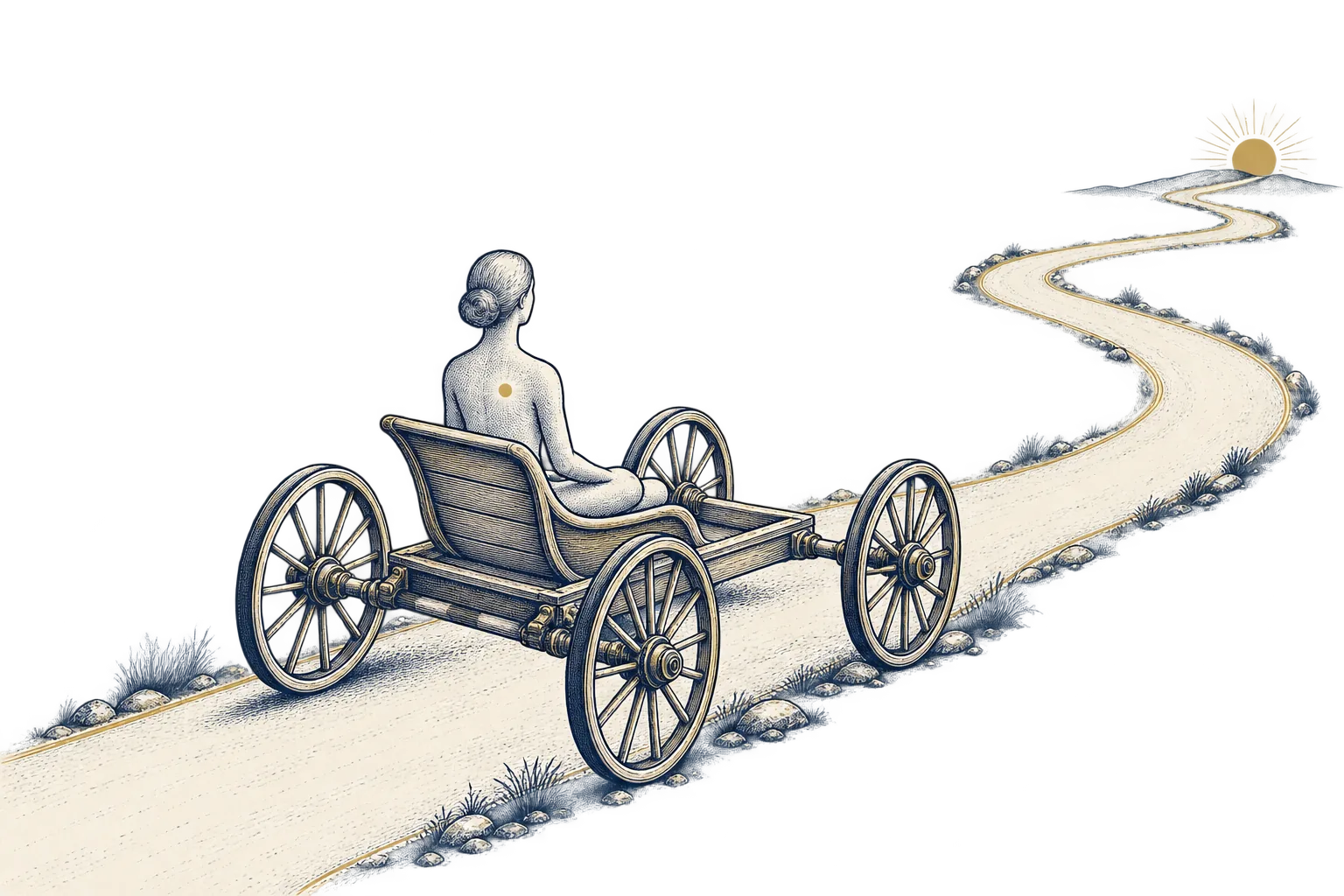
Welcome to Day 4
Welcome to Day 4. Explore the four Purushārthas and how they work together in daily life. Then bring Karma Yoga to one important task and use the reflection page to consider how your actions relate to your values.
The shape of today
- Opening — The PathTurn towards the Path and begin Stage 2: Calming the Mind.
- The teaching — The four PurushārthasExplore Dharma, Artha, Kama and Moksha.
- The teaching — Integration and the River of LifeBring the four dimensions together.
- Value and intentional activity — Karma YogaPractise Karma Yoga through one important task.
- Scientific quadrant — Stage 2 beginsRead the scientific account of priorities and alignment.
- Closing and reflectionReflect on values, effort and outcomes.
- A quiet place to read and sit comfortably.
- A pen for the reflection page.
- One important task to approach with full attention, and a moment for one slow breath before you begin.
- Today’s meditation audio: Nadi Shodhana and belly-focused meditation.
Life can get busy. Take more than 21 days if you need to; there is no need to rush. If you cannot move to the next day of TLM Basic, continue practising the Value of the Day, Intentional Activity and Meditation from the last day you completed. When you are ready, resume the programme from where you left off.
The Path

First, the Traveller. Who am I? Then the Goal. What am I truly seeking?
Yesterday, we discovered that while happiness comes and goes, what we really long for is a deeper peace—and ultimately the quiet fullness that the wisdom traditions call Bliss.
Today we move to the third element of the journey. The Path.
Knowing the destination is important. But unless we know how to live each day, even the clearest goal remains only an idea.
The Indian wisdom traditions answered this question with remarkable practicality. They did not reject work, family, wealth or enjoyment. Instead, they showed us how to live fully in the world while steadily growing in inner freedom.
That framework is called the Purushārthas—the four legitimate human endeavours.
Today also marks an important milestone. For the past three days, we have been understanding the mind. From today, we begin Stage Two of TLM—Calming the Mind. And one of the most powerful ways to calm the mind is to organise life wisely.
A complete map for living
These teachings were never meant only for monks or renunciates. They were created for ordinary people—people with families, careers, responsibilities, ambitions and relationships. People like you and me.
The traditions recognised that every human being seeks four things. We seek values. We seek security. We seek enjoyment. And we seek freedom. Problems arise not because these needs exist, but because they become disconnected from one another.
We chase wealth without values. Pleasure without wisdom. Or success without inner growth. That is when life becomes fragmented. The Purushārthas restore balance. They describe four dimensions of a complete human life:
These are not competing goals. They are four dimensions of one integrated life. Let us look at each of them.
The foundation
Dharma is often mistaken for religion or duty. Its deeper meaning is right order—living with integrity, responsibility and alignment with your deepest values.
Think of Dharma as the foundation of a house. If the foundation is weak, the entire structure becomes unstable. The same is true of life. Success without integrity creates anxiety instead of fulfilment. Relationships without trust become fragile. Achievement without values leaves an inner emptiness.
Dharma does not limit life. It gives direction to life. It ensures that everything else we pursue contributes to lasting wellbeing instead of temporary excitement.
Living fully
Artha includes every form of security that helps us live a stable and meaningful life. It includes financial wellbeing. Meaningful work. Professional growth. Respect. Recognition. A sense of belonging. Feeling safe and supported.
The traditions never suggested that these aspirations were unspiritual. On the contrary, they recognised that when our basic needs are reasonably met, the mind becomes available for deeper enquiry.
The third dimension is Kama. Kama is the enjoyment of life. Love. Friendship. Beauty. Music. Nature. Celebration. All the experiences that bring richness to human life.
The traditions never rejected pleasure. They simply reminded us that pleasure cannot become the purpose of life. Without Dharma, pleasure becomes compulsion. With Dharma, it becomes nourishment.
So neither Artha nor Kama is an obstacle to inner growth. Both are essential dimensions of a balanced life. When guided by wisdom, they support the journey instead of distracting us from it.
The highest human possibility
Over the past three days, we have repeatedly explored one question: Who am I? If we are more than our changing thoughts, emotions and roles… If there is an awareness that quietly observes every experience… Then the deepest purpose of life is to recognise and live from that awareness. That is Moksha.
It is not running away from the world. It is freedom within the world. It is discovering that while circumstances may continue to change, our deepest peace need not depend entirely on them.
When Dharma guides our actions… Artha provides stability… And Kama brings healthy joy… Moksha gives all three a deeper direction. It reminds us to live fully in the world—without becoming lost in it.
If these four dimensions are all important, the next question becomes: How do they work together in daily life? The wisdom of the Purushārthas lies not in choosing one over another, but in learning to integrate them.
The four dimensions together
That is not what the traditions teach. All four operate together. Every day. In every important decision. The real question is never, “Should I choose success or inner peace?” The better question is, “Can I pursue success in a way that strengthens my peace?”
Can I earn wealth without compromising my values? Can I enjoy life without becoming dependent upon it? Can I fulfil my responsibilities while continuing to grow inwardly?
When these four dimensions become aligned, inner conflict reduces. The mind becomes quieter.
A balanced life does not reject worldly success or enjoyment. It learns to pursue them wisely, guided by Dharma and grounded in inner freedom.
And that is why today marks the beginning of Stage Two—Calming the Mind.
Karma Yoga
It is Karma Yoga, the underlying theme of the Bhagavadgita. Karma Yoga means giving your best to every action without allowing your identity to depend upon the outcome.
Imagine an actor on stage. During the performance, the actor gives everything. But when the curtain falls, the role is left behind. Life asks the same of us. Work wholeheartedly. Love wholeheartedly. Serve wholeheartedly.
But remember that your worth is greater than your latest success or failure. Success deserves gratitude. Failure deserves learning. Neither defines who you are.
This is not indifference. It is freedom. The freedom to engage completely without becoming imprisoned by results.
TLM contextualises Karma Yoga for modern-day living in the form of ENA, the fruit of Inner Governance.
Inner Governance
“The disciplined capacity to regulate attention, emotion and behaviour even under pressure — in alignment with personal values and institutional ethos to fulfil the envisaged goal.”
Engaged Non-Attachment (ENA)
ENA is
- Full presence in every role
- Action without egoic ownership
- Stability under pressure
- Giving fully; clinging to nothing
- Withdrawal from ego, not from duty
ENA is not
- Reduced involvement
- Emotional distancing
- Lowering of standards
- Indifference to outcomes
- Withdrawal from responsibility
Values-based action
- Before you begin, pause for one slow breath and ask yourself: “Why am I doing this?” Is this action driven by fear… By the need for approval… Or by my values?
- Then give the task your full attention.
- When you finish, instead of asking, “Was I successful?” Ask, “Did I give my best?” If the answer is yes, allow yourself to feel content.
That is Karma Yoga in daily life.
Stage 2: Calming the Mind
The Scientific Quadrant explains contemplative practices through current scientific understanding of psychology, behavioural science and neuroscience. The mechanisms described indicate how these practices may influence attention, emotional regulation, behaviour and wellbeing. Scientific understanding continues to evolve, and these explanations are not guarantees of specific outcomes. Individual experiences may vary.
Today’s teaching explored the four Purushārthas—Dharma, Artha, Kama and Moksha—and the importance of living a balanced and integrated life.
Modern neuroscience suggests that many forms of stress, dissatisfaction and inner conflict arise not because we lack ability, but because different parts of our life are pulling us in different directions. One part of us seeks achievement. Another seeks comfort. Another seeks relationships. Another seeks meaning and inner freedom.
When these motivations compete with each other, the mind experiences friction, confusion and exhaustion.
Today’s practices help cultivate a different capacity: the ability to align our actions with our values, our goals with our deeper aspirations, and our daily choices with what truly matters. This alignment reduces internal conflict and creates greater clarity, stability and purpose.
Today’s brain systems
Executive Control Network (ECN)
The Executive Control Network supports planning, self-regulation, decision-making and long-term goal pursuit. It helps us choose actions that reflect our values rather than simply reacting to immediate impulses. This network is especially active when we act from Dharma rather than convenience.
Default Mode Network (DMN)
The Default Mode Network helps create our sense of personal identity and life narrative. It constantly evaluates questions such as: Who am I? What matters to me? What kind of life am I building? When these answers become clearer, life feels more coherent and meaningful.
Salience Network
The Salience Network helps determine what deserves our attention. It acts as an internal prioritisation system, helping us distinguish between what is merely urgent and what is genuinely important. A well-functioning Salience Network helps us stay aligned with our deeper priorities rather than being constantly distracted by short-term demands.
How today’s practices train the brain
| Practice | Brain system trained | Likely result |
|---|---|---|
| Reflection on the Four Purushārthas | Default Mode Network & Executive Control Network | Greater clarity about life’s priorities and long-term direction |
| Karma Yoga | Executive Control Network | Increased ability to focus on right action rather than attachment to outcomes |
| Intentional Activity: Values-Based Action | Executive Control Network & Salience Network | Stronger alignment between values and daily behaviour |
| Nadi Shodhana and belly-focused meditation | Attention, Emotional Regulation and Self-Regulation Systems | Greater mental steadiness, reduced internal conflict and improved clarity |
Brain Body Behaviour
| Level | What changes through practice? | What you may notice in daily life |
|---|---|---|
| Brain | Improved prioritisation, stronger self-regulation and greater alignment between goals and values | Increased clarity when making decisions and setting priorities |
| Body | Reduced stress generated by conflicting demands and competing motivations | Greater sense of ease, steadiness and emotional balance |
| Behaviour | More consistent actions, fewer impulsive choices and greater integrity between beliefs and behaviour | Better decisions, healthier habits and stronger follow-through on commitments |
Why repetition matters
Every time you choose an action aligned with your values rather than a short-term impulse, you strengthen neural pathways associated with self-regulation and purposeful living.
Every time you act with awareness rather than compulsion, the brain becomes more efficient at integrating competing priorities. This is neuroplasticity in action.
Over time, repeated moments of alignment gradually transform scattered effort into a coherent way of living. What begins as an intentional practice eventually becomes a natural habit.
Day 4 scientific takeaway
A well-organised life creates a well-organised mind.
The teachings of the Purushārthas remind us that human flourishing is not achieved by pursuing success, pleasure, duty or freedom in isolation. It emerges when these dimensions are integrated into a coherent way of living.
Today’s practices help train the brain to reduce inner conflict, clarify priorities and act with greater alignment between values, actions and aspirations. The more aligned our life becomes, the more energy becomes available for growth, wellbeing and inner freedom.
- Dharma, Artha, Kama and Moksha are presented as dimensions of one integrated life.
- Artha and Kama flow within the banks of Dharma; Moksha shines as the ultimate goal, symbolised by the sun.
- Karma Yoga asks us to give our best to action without making our worth depend on the outcome.
- Before one important task, ask “Why am I doing this?”; afterwards, “Did I give my best?”
- Today begins Stage 2: Calming the Mind.
Calming the Mind
When these four dimensions become aligned, inner conflict reduces. The mind becomes quieter. That is why today marks the beginning of Stage Two—Calming the Mind.
Today’s practices help train the brain to reduce inner conflict, clarify priorities and act with greater alignment between values, actions and aspirations. The more aligned our life becomes, the more energy becomes available for growth, wellbeing and inner freedom.
Meditation — Belly-focused meditationPress play on the meditation audio, sit comfortably, and simply practise.Today’s practice trains attention, emotional regulation and self-regulation: greater mental steadiness, reduced internal conflict and improved clarity.
Use the course meditation recording for the guided practice. The timer below is a quiet companion for practising on your own.