Welcome to Day 21
Today closes TLM Basic. There is no new ground to cover: read slowly, pause with the figures, revisit your Four Wheels with a pen, and close with the Day 21 meditation.
The shape of today
- Opening — Twenty-one days in one viewThe Journey of Life with all four wheels lit, and one final question.
- The teaching — The four YogasJñāna, Bhakti, Karma and Rāja: the Gita’s architecture for an integrated life.
- Anāsakti — ENA in actionThe quality that holds the four together, and the Traveller through roles.
- Integration activity — Revisiting the Four WheelsThe same wheel at four moments: Day 1, Day 6, Day 14 and Day 21.
- From tomorrow onward — Keeping TLM aliveBegin again, or follow what resonated; life becomes the practice field.
- The ancient roots and the scientific quadrantFrom the senses to the Self, and what TLM has been training in brain and body.
- Closing — The journey continuesUjjayi and Open Awareness.
- A quiet place to read, and a pen for the activity and the reflection spaces.
- Your Day 1, Day 6 and Day 14 Wheel of Life scores, if you kept them.
- The Day 21 meditation audio.
Life can get busy. Take more than 21 days if you need to; there is no need to rush. If you cannot move to the next day of TLM Basic, continue practising the Value of the Day, Intentional Activity and Meditation from the last day you completed. When you are ready, resume the programme from where you left off.
Twenty-one days in one view
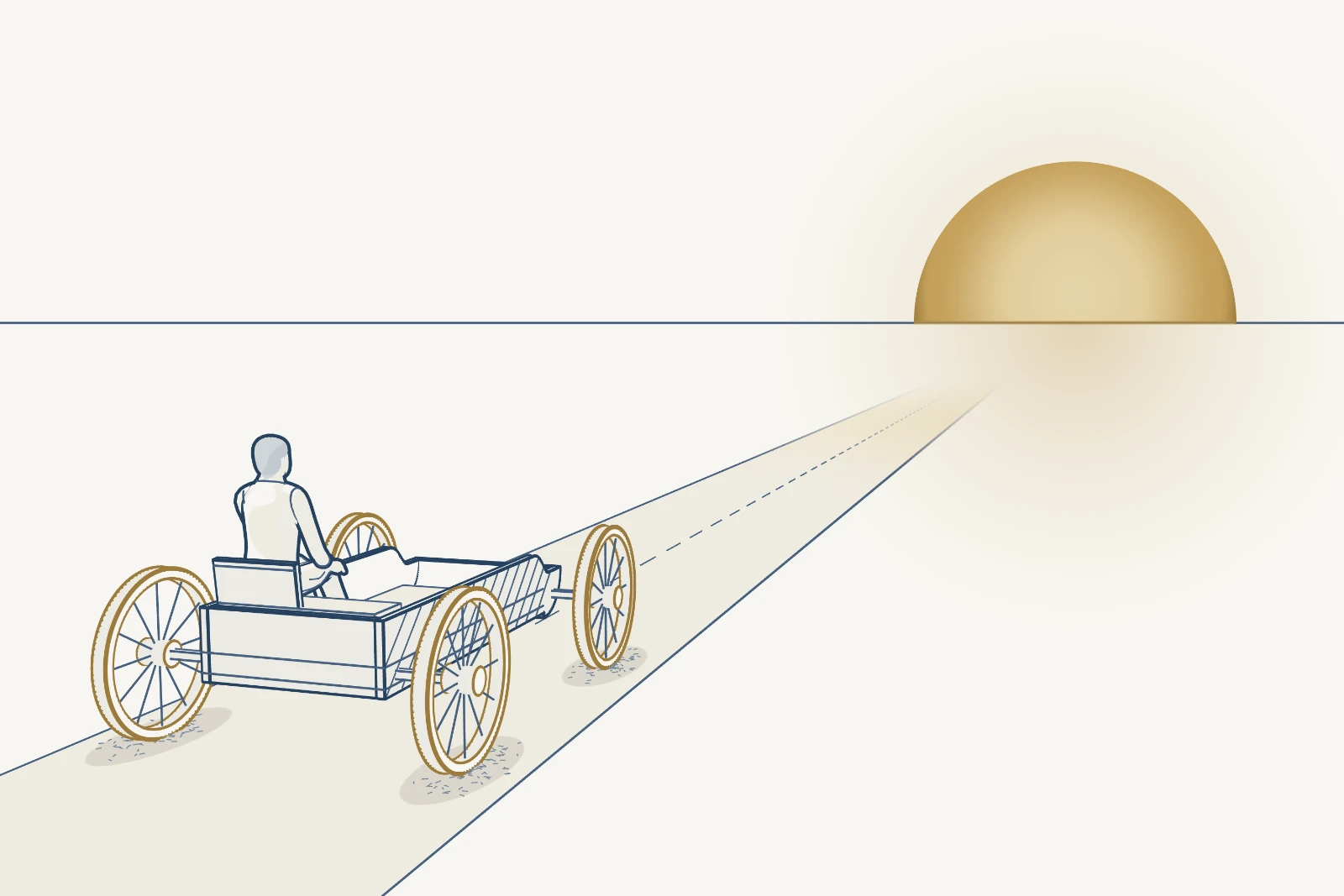
Today we do not cover new ground. Today we step back and see what these twenty-one days have been building toward.
Not a perfect life.
Not a life without difficulty.
But a wiser way of living an ordinary human life.
In Week 1, we began with the Traveller. We asked: Who am I?
We looked at the Goal — what we are really seeking beneath all our pursuits. We explored the Path — the Purusharthas, legitimate human endeavours, through which we engage fully with life. And we built the Vehicle: the four wheels through which life is actually lived — relationships, finances, work and values.
Then, in Week 2, we turned to the Instruments through which the Traveller operates — the body, the breath, the mind and the intelligence.
We worked with movement, nutrition and sleep. We explored stress, attention, resilience and the training of the mind.
For twenty-one days, you have been practising. Not simply learning about Inner Governance, but beginning to train it.
And in Week 3, we brought that understanding into life itself.
Relationships.
Money.
Work.
Values.
The teaching moved from understanding life to living it.
And that is where all of this now comes together.
The terrain has not changed.
There will still be uncertainty.
There will still be success and disappointment.
There will still be difficult people, difficult decisions and difficult days.
What can change is the way you meet them.
What has changed is not the terrain.
What has changed is the Traveller’s relationship to it.
Today, we bring the journey together. And we ask one final question:
The Gita’s architecture for an integrated life
It was spoken on a battlefield, to a person who could not walk away from his duty, in the middle of his confusion and difficulty.
That context matters. The Gita’s teaching is not about withdrawing from life. It is about how to live fully within life without losing yourself in it.
At its centre, the Gita gives us four dimensions of an integrated life — not four separate paths.
Jñāna Yoga — the yoga of true knowledge
The first is Jñāna Yoga — the yoga of true knowledge.
From Day 1, TLM has pointed toward one recognition central to the wisdom traditions.
I am not the body.
I am not the senses.
I am not the mind.
I am the one who observes them.
The body is observed.
The mind is observed.
Thoughts, memories, opinions and reactions are observed.
Jñāna Yoga invites us to investigate whether the observer can be reduced to any of the changing things being observed.
That recognition — not merely as a philosophical idea, but as something you begin to see in your own experience — is Jñāna.
And from that recognition comes Viveka: the capacity to distinguish what is real from what is merely passing, like negative emotions, difficult life circumstances and rude persons.
And from Viveka comes Vairāgya: a natural freedom from compulsive clinging. The understanding that ‘This too shall pass.’
Jñāna Yoga, therefore, is not a specialised path for scholars. It is what you have been practising since Day 1.
Bhakti Yoga — wholehearted dedication
The second is Bhakti Yoga — the yoga of wholehearted dedication.
Bhakti is often understood as devotion to God or a deity. For those for whom that is genuine, it is exactly that.
But the Gita’s description in Chapter 12 also points to something broader: the qualities of a person whose heart is no longer organised entirely around the ego.
- Freedom from hatred.
- Equanimity in pleasure and pain.
- Contentment.
- Steadiness.
- Non-harm.
- And freedom from ego-driven agitation.
Bhakti is wholehearted dedication to something genuinely larger than the ego.
That may be a deity.
It may be a cause.
It may be your studies, work, your family, your community, your calling, or a set of values you refuse to compromise.
The common thread is this: the ego is no longer the only centre of your life.
Karma Yoga — the yoga of right action
The third is Karma Yoga — the yoga of right action. It has been the backbone of this final week.
The Gita’s famous teaching (Verse 2.47):
Karma Yoga does not mean caring less. It means acting fully without making your inner wellbeing dependent upon the outcome.
You give the action everything you have.
You prepare.
You commit.
You perform.
And then you release your claim over what comes back.
Because the outcome is never entirely within your control. This is the spirit of Engaged Non-attachment (ENA) in TLM.
The outcome has arrived.
Perhaps it is what you wanted.
Perhaps it is not.
The question now is: How do you receive it?
ENA is not resignation. It is the capacity to receive what comes with an open mind, recognise what lies beyond your control, and remain responsible for the quality of your action.
Rāja Yoga — the yoga of inner governance
The fourth is Rāja Yoga — the yoga of the mind and inner governance. This is the dimension TLM has been most systematic about.
Rāja Yoga is sustained practice: training attention, regulating the breath, observing the mind and developing the capacity to remain steady.
Twenty-one days of TLM have been an introduction to Rāja Yoga. And Rāja Yoga provides the ground on which the other three can operate.
requires a mind clear enough to see without distortion.
requires a heart open enough to dedicate without constantly asking, What do I get?
requires sufficient inner steadiness to act fully without being consumed by the anxiety of outcome.
Rāja Yoga strengthens that ground.
Your daily pranayama and meditation are therefore not separate from the Gita’s architecture. They are Rāja Yoga made practical.
The Gita as integrated action science
And there is something remarkable about this architecture.
The Gita described these principles thousands of years ago. Modern psychology and leadership research have approached some of the same human problems through a completely different route.
Research on psychological safety, for example, examines what happens when people can participate and act without constantly protecting themselves from interpersonal threat.
Research on intrinsic motivation examines what happens when people act from genuine engagement rather than being driven primarily by external rewards and punishments.
These are not the Gita’s terms. And modern research does not “prove” the Gita. These findings offer useful points of comparison, while the underlying concepts and purposes remain distinct.
Different traditions.
Different methods.
Different languages.
Yet again and again, they point toward a similar human possibility:
A person performs better when action is not dominated by fear, compulsion, ego-protection and the desperate need to control outcomes.
That is one of the reasons TLM brings together ancient wisdom and modern science. Not to make one validate the other.
But to ask:
And the Gita gives us one extraordinarily coherent answer:
One integrated life
These are not four separate practices that you choose between. They are four simultaneous dimensions of one life.
governs how you see and understand.
governs what you dedicate yourself to and how you relate.
governs how you act and how you receive the results.
sustains the inner ground from which all three operate.
And now we arrive at the quality that holds them together.
That is where the journey of TLM now takes us.
Anāsakti — ENA in action
But what happens when these four are not merely understood separately, but begin to operate together in one life?
The Gita gives us a powerful expression:
And Anāsakti is easily misunderstood.
It does not mean indifference.
It does not mean caring less.
It does not mean reducing effort or responsibility.
You prepare fully.
You act wholeheartedly.
You give the action everything you have.
And yet, you do not make your peace, your worth or your identity dependent upon what comes back.
You do your part.
You receive what comes.
And you remain inwardly free.
That is Anāsakti.
Revisiting the Four Wheels of Life
- Relationships
- Work and Profession
- Finances
- Values and Ethics
Today, on this final day of TLM, pause for a few minutes and revisit those reflections.
Your Wheel of Life
Record your scores from 1 to 10. Your entries are saved in this browser and gathered in your notebook.
Your earlier checkpoints
| Area of life | Day 1 | Day 6 | Day 14 | Day 21 |
|---|---|---|---|---|
| Relationships | — | — | — | — |
| Profession and Work | — | — | — | — |
| Finances | — | — | — | — |
| Values and Ethics | — | — | — | — |
A dash means no score has been saved here.
Without judging yourself, ask:
There is no right or wrong answer.
Keeping TLM alive
Not another programme.
Not another syllabus.
A way of living built from what you have already begun.
The important thing now is continuity.
Because twenty-one days can introduce a practice.
But it is repetition that gives practice depth.
And there is no single formula you have to follow. You have two simple choices.
Begin again
You can return to Day 1. Go through the TLM practices again, in sequence.
You will hear the same teachings. You will practise many of the same meditations and pranayamas. But you will not be the same person who heard them twenty-one days ago.
A teaching that sounded theoretical on Day 3 may speak differently to you on Day 24. A meditation that felt difficult the first time may now feel familiar. A value that you understood intellectually may now reveal itself in an actual situation in your life.
Repetition is not going backwards. It is going deeper.
Follow what resonated
Or choose the practices that have genuinely resonated with you.
Perhaps there was a meditation in which you felt particularly peaceful. Perhaps there was a pranayama that helped you feel settled, clear or alive. Perhaps one practice seemed to suit you better than the others.
Choose that. Practise it regularly. You do not have to keep changing practices simply because the course has ended. Find what helps you become more present, more steady and more alive — and stay with it.
The point is not to collect practices. The point is to practise.
And whichever option you choose, keep one thing alive during the day:
The real practice is not only when you are sitting with your eyes closed.
- It is when someone irritates you.
- When an outcome disappoints you.
- When you are tempted to act against your values.
- When success arrives.
- When you have to make a difficult choice.
- When you are working.
- When you are relating.
That is where Inner Governance becomes real.
TLM prepares you. Life gives you the practice field.
The ancient roots of TLM
More than two thousand years ago, the Upanishads described a hierarchy within the human being — a progression from what is immediately experienced to what is deepest.
Sri Krishna later presents the same hierarchy in the Bhagavad Gita:
This teaching echoes the earlier vision of the Katha Upanishad, which we encountered through the Chariot metaphor.
And now, looking back from Day 21, something becomes clear.
When we began TLM with the question “Who am I?”, we were not beginning an abstract philosophical enquiry.
We were beginning a journey inward — from the way we act and react, toward the mind that drives those reactions, the intellect that can guide the mind, and finally toward the recognition of the Traveller — the Self.
Almost every practice in TLM has been training one of these dimensions.
What TLM has been training
| Level | What TLM has been training |
|---|---|
| Senses | Habits, health, relationships, money, values, behaviour and conscious action |
| Mind | Meditation, emotional awareness, observation, attention and inner calm |
| Intellect | Reflection, discernment, life design, Purusharthas, inquiry and wise decision-making |
| Self | The Traveller, the Witness perspective and the exploration of “Who am I?” |
This mapping is TLM’s explanatory framework, not an exact scientific one-to-one mapping.
The language of the Gita and Upanishads is different from the language of modern neuroscience. Yet there is an important meeting point.
Human development requires our deeper capacities to increasingly guide our more reactive tendencies.
And that is precisely what TLM has been helping you practise over these twenty-one days.
Now let us look at the same journey through the lens of modern science.
What has TLM been training?
The Scientific Quadrant explains contemplative practices through current scientific understanding of psychology, behavioural science and neuroscience. The mechanisms described indicate how these practices may influence attention, emotional regulation, behaviour and wellbeing. Scientific understanding continues to evolve, and these explanations are not guarantees of specific outcomes. Individual experiences may vary.
You have also been repeatedly exercising certain capacities of the brain and body.
- Meditation.
- Pranayama.
- Attention.
- Emotional regulation.
- Reflection.
- Values-based action.
- Even the simple act of pausing before reacting.
So what might this repeated practice be training?
We can look at it through three broad brain systems — and then through the body.
1. Prefrontal / executive-control networks
The prefrontal regions of the brain are involved in functions such as attention, planning, working with information, inhibiting impulses and regulating behaviour.
Many TLM practices repeatedly ask you to do exactly that:
Pause. Observe. Choose.
When you notice a thought without immediately following it, you practise attentional control.
When you notice an emotional reaction and choose how to respond, you practise regulation.
When you return your attention to the breath during meditation, you practise bringing a wandering mind back.
The point is not that twenty-one days have transformed your prefrontal cortex.
The point is that you have repeatedly exercised the capacities it supports.
And repeated practice is how trainable capacities become more accessible.
2. Amygdala and emotion-related circuits
The amygdala is part of the brain’s system for detecting and responding to emotionally significant or potentially threatening information.
TLM does not teach you to eliminate emotion. It teaches you to change your relationship with emotion.
Through meditation, awareness, pranayama and reflective practices, you repeatedly create a small but important space between:
That space is where choice becomes possible.
Research on meditation and related practices suggests changes in how emotion-related brain systems interact with regulatory networks, although the size and consistency of these effects vary across studies and practices.
That distinction matters.
3. Default Mode Network — the narrative self
The third is the Default Mode Network, or DMN. It is associated with processes including self-referential thinking, autobiographical memory and thinking about the past and future.
The mind naturally creates stories:
What happened to me?
What will happen to me?
What does this mean about me?
What will people think of me?
Many TLM practices ask you to notice this activity without automatically becoming identified with it.
That takes us back to the question with which TLM began:
You are not trying to destroy the narrative mind. You are learning to observe the narrative without being completely captured by it.
This is one place where the contemplative insight of TLM and modern neuroscience can meaningfully enter into conversation.
And what about the body?
TLM has also repeatedly worked with the body through movement, sleep, nutrition, pranayama, breathing, meditation and stress regulation. These practices can influence physiological states such as arousal, attention and recovery.
The breath is particularly interesting because it gives us a voluntary doorway into an otherwise largely automatic system.
You cannot simply command yourself to stop being stressed.
But you can change your breathing.
And breathing can influence autonomic regulation and how the body responds to stress.
So when TLM teaches you to:
that is not merely philosophical advice. It is also a practical way of working with the brain-body system.
The important qualification
There is something important to remember.
Neuroscience does not tell us that every person completing twenty-one days of TLM will experience identical brain changes. Meditation research is substantial, but findings vary with the practice, duration, population and study design.
TLM therefore does not need exaggerated claims.
The stronger statement is simpler:
For twenty-one days, you have repeatedly exercised attention, awareness, emotional regulation, self-observation and intentional behaviour.
These are trainable human capacities. And when you practise them repeatedly, your brain and body participate in that learning.
That is neuroplasticity in its most useful sense:
Repeated practice can contribute to changes in the brain, although the nature and extent of these changes depend on the activity, duration, individual and context.
One final scientific insight
Every time you pause instead of reacting, observe instead of judging, breathe instead of escalating, or choose according to your values instead of impulse, you are rehearsing a different way of being.
That is what TLM has been doing for twenty-one days.
Not promising a transformed brain in twenty-one days.
Beginning to train one.
And perhaps that is the most useful scientific insight of all:
- Know clearly, dedicate wholeheartedly, act fully, govern yourself.
- Anāsakti: fully engaged, never inwardly bound by the outcome.
- Repetition gives practice depth, and change itself is trainable.
The journey continues
Perhaps today you do not have a final answer. That is perfectly alright.
The purpose of this journey was never to hand you an answer. It was to help you ask the question more deeply.
Over these twenty-one days, you have explored your body, your mind, your values, your relationships, your actions and your purpose. You have learnt practices that can bring greater clarity, steadiness and peace into your life.
TLM Basic has brought you to a beginning, not an endpoint. What follows is the work of practising, observing and deepening through daily life.
The rest cannot be learnt from a course.
It can only be learnt through living.
The real classroom is now your daily life.
- Your relationships.
- Your work.
- Your successes.
- Your failures.
- Your moments of joy.
- And your moments of difficulty.
These will become your teachers.
So keep walking.
Keep observing.
Keep practising.
Keep returning to awareness.
And keep asking the deepest question:
but in the way you live.
Meditation — Open AwarenessPress play on the meditation audio, sit comfortably, and simply practise.Your meditation is ready. Ujjayi can help settle the body and breath. Open Awareness offers a space in which what you have understood can begin to become more natural in daily life.
Press play.
Use the course meditation recording for the guided practice. The timer below is a quiet companion for practising on your own.