
Welcome to Day 20
Yesterday we completed the fourth wheel of the Vehicle. Today we step back and look at the whole journey: its goal, the Inner Governance that every practice in TLM has been building, and where the fulfilment we seek is actually found. Read slowly, in one sitting, and let the reflection questions at the end stay with you.
The shape of today
- Opening — Humanity’s oldest searchThe complete Journey of Life, and the horizon that keeps moving.
- The teaching — The Bhagavad GitaChapter 5, Verse 21 and Chapter 6, Verse 21: a happiness beyond the senses.
- Inner Governance and the Seven Stages of Inner GovernanceThe single objective behind every practice of the past twenty days.
- The three layers and the five toolsWhy change is difficult, and how TLM reaches every layer of the mind.
- The chariot revisited and the 4-3-5 systemEvery component trained: many practices, one transformation.
- Living with Inner GovernanceENA and EVA, the two wings: our relationship with outcomes and with choices.
- The great resolution, reflection and meditationThe final insight; Ujjayi Breathing and Loving-Kindness Meditation.
- A quiet place to read, and a pen for the reflection spaces.
- The Day 20 meditation audio (15 minutes).
- A few unhurried minutes at the end for five reflection questions.
Life can get busy. Take more than 21 days if you need to; there is no need to rush. If you cannot move to the next day of TLM Basic, continue practising the Value of the Day, Intentional Activity and Meditation from the last day you completed. When you are ready, resume the programme from where you left off.
Humanity’s oldest search
Why did you study?
Why did you work hard?
Why did you seek financial security?
Why did you pursue relationships, achievement, recognition or success?
The answers may differ from person to person, but beneath them lies a common aspiration.
Earlier in this course, on Day 3, we explored a simple but profound progression that appears across many wisdom traditions:
At first, most people seek happiness through favourable circumstances and pleasant experiences. As understanding deepens, the search gradually shifts from excitement and pleasure towards inner peace. With further growth comes the possibility of an even deeper fulfilment — a state often described by the wisdom traditions as Bliss.
This raises an important question. If Happiness, Peace and Bliss are the destination, where exactly are we seeking them?
Most human beings instinctively assume that fulfilment lies somewhere ahead.
A better job.
A better relationship.
Greater wealth.
Greater recognition.
A more favourable future.
Something yet to be achieved. Something yet to be acquired.
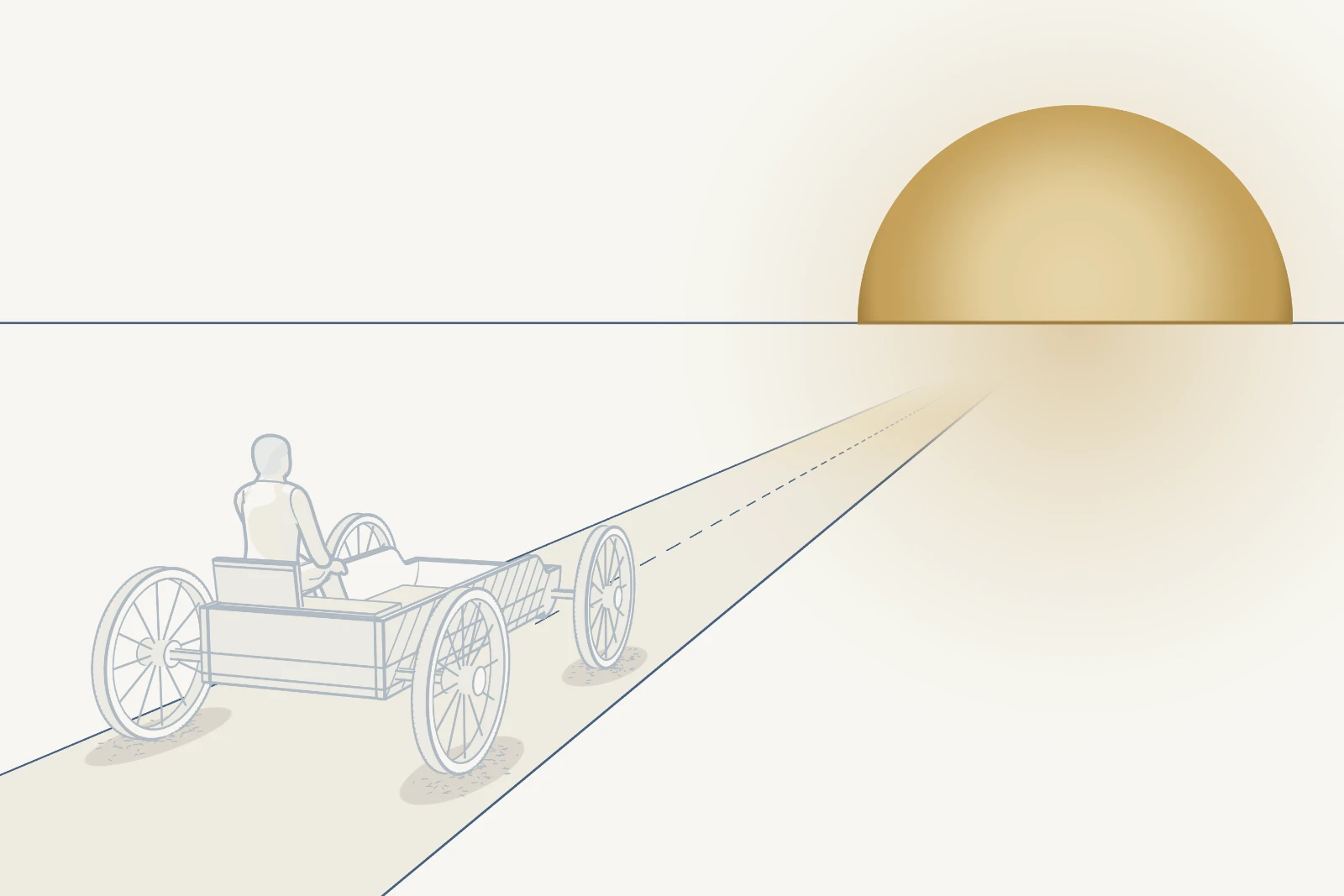
The entire structure of the Journey of Life is built upon this assumption. The traveller moves. The vehicle progresses. The path unfolds. The goal appears somewhere in the distance.
But what if this assumption is incomplete?
This is where the wisdom traditions offer a radically different perspective.
And where is it to be found?
The Bhagavad Gita
The Bhagavad Gita repeatedly encourages us to examine the source of our happiness.
Most of us naturally believe that happiness comes from favourable circumstances, pleasant experiences and successful outcomes. While these undoubtedly contribute to our wellbeing, Krishna invites us to look deeper.
In Chapter 5, Verse 21, he says:
This is a profound observation.
Krishna is not asking us to reject the world. He is not suggesting that achievement, relationships or material wellbeing are unimportant. Rather, He is pointing out a limitation. Anything that depends entirely upon external circumstances will remain vulnerable to change.
Achievements can be lost.
Relationships evolve.
Health fluctuates.
Fortunes rise and fall.
If our happiness depends exclusively upon these external conditions, our happiness will remain unstable.
The Gita therefore invites us to discover a deeper source of wellbeing — one that is not entirely dependent upon what is happening around us.
A deeper possibility
Krishna then takes this inquiry even further. In Chapter 6, Verse 21, while describing the fruits of a disciplined and contemplative mind, he says:
This verse introduces a remarkable possibility.
The deepest fulfilment available to a human being may not be sensory in nature. It may not arise from possession, stimulation or achievement. It may arise from a different dimension of experience altogether.
Krishna describes it as a happiness that is:
- beyond the senses
- not dependent upon external objects
- recognised through a refined intellect
This immediately raises an important question. What kind of intellect is capable of recognising such fulfilment?
Certainly not an intellect that is constantly distracted.
Not an intellect dominated by impulses.
Not an intellect trapped in reactivity and habit.
The intellect Krishna describes must be:
- clear
- disciplined
- reflective
- emotionally balanced
- capable of seeing beyond immediate gratification
And this brings us directly to one of the central ideas of TLM.
Inner Governance
For the past twenty days, TLM has not merely been teaching concepts. It has been cultivating a particular quality of mind.
A mind that is more aware.
More balanced.
More reflective.
More capable of responding wisely rather than reacting impulsively.
In TLM, we call this capacity Inner Governance.
Inner Governance
“The disciplined capacity to regulate attention, emotion and behaviour even under pressure — in alignment with personal values and institutional ethos to fulfil the envisaged goal.”
The quality of our life ultimately depends upon the quality of our inner governance.Inner Governance is the cultivation of an intellect that can guide the mind rather than being controlled by it.
From this perspective, the various elements of TLM begin to make sense.
The practices.
The reflections.
The values.
The meditations.
The discussions on health, relationships, finances and purpose.
They have all been directed towards a single objective: the development of Inner Governance.
The Seven Stages of Inner Governance
Over the past twenty days, we have explored many ideas, practices and perspectives. At first glance, these may have appeared to be separate topics. In reality, they were all part of a single process: the progressive training of the mind.
Just as physical fitness develops through systematic training of the body, Inner Governance develops through systematic training of the mind. This journey can be understood through the Seven Stages of Inner Governance.
The three layers of the mind
If lasting fulfilment depends upon Inner Governance, why is transformation often so difficult?
Why do people understand what is right, yet struggle to live accordingly?
Why do insights sometimes fade, while old habits continue to persist?
The answer lies in the fact that the mind is not a single layer. Human experience operates through multiple levels of conditioning, awareness and habit. For lasting transformation to occur, all these layers must be addressed.
The Seven Stages of Inner Governance were designed precisely with this understanding.
Some stages help us understand and calm the conscious mind.
Others strengthen attention and awareness.
Still others help us identify and transform deeper patterns residing below conscious awareness.
Change may remain fragile when it addresses intellectual understanding alone, without also working with emotional patterns, habits and conditioning that operate outside immediate awareness.
Only then do new values, habits and ways of being become natural and sustainable.
The five tools of transformation
How does TLM work with all three layers simultaneously? The answer lies in the five daily practices that have accompanied every day of the programme.
These five elements were not chosen randomly. Each has a distinct role in the TLM framework, and together the five practices offer complementary ways to support inner development. Together, they create a comprehensive process of inner transformation.
The logic of the five tools in TLM
The obvious question now becomes: Why did TLM spend twenty days talking about health, relationships, values, finances, profession, attention, meditation and neuroscience if the core teaching was imparted in the first few days only?
This is where the iconic Chariot Metaphor of the Katha Upanishad and the Bhagavad Gita enters.
The chariot revisited
Why the five tools exist
The five daily practices of TLM were designed to strengthen different components of the chariot. Transformation cannot occur merely through information. Every component of the human system must be trained.
Some practices work primarily at the level of the senses.
Some work at the level of the mind.
Some strengthen the intellect.
Some influence deeper subconscious conditioning.
Some improve the condition of the vehicle itself.
Together they create Inner Governance.
How the five tools work on the chariot
The primary targets below are TLM’s explanatory model of how each tool works on the chariot and on the layers of the mind, not experimentally established one-to-one mappings.
Spiritual & Philosophical Teaching
Provides direction to the charioteer. It strengthens the intellect. Without wisdom, the charioteer cannot guide the journey.
Value of the Day (Based on Indian Wisdom Traditions)
Values give something tangible to the senses to do or not do. Values gradually purify and align the mind. They transform emotional tendencies and habitual reactions. A stronger mind allows the intellect to guide behaviour more effectively.
Intentional Activity
Intentional activities convert understanding into behaviour. They train habits and daily actions. They create new conditioning through practice.
Scientific Quadrant (SQ)
The Scientific Quadrant offers psychological and neuroscientific perspectives that can help participants understand the rationale for the practices. Greater understanding may support commitment, although motivation and adherence also depend on individual and contextual factors.
Meditation
Meditation works across all layers. It gradually transforms subconscious conditioning.
The 4-3-5 system of TLM
The 4 is the Journey of Life — the Traveller with his Instruments (Body-mind complex), the Goal, the Path, and the 4-wheeled Vehicle.
The 3 are the three layers of the mind that must be addressed for a lasting transformation.
The 5 are the five tools that do not merely influence conscious thought. They work simultaneously upon:
- Gross Mind
- Subtle Mind
- Subconscious Mind
This is why TLM combines knowledge, reflection, action, science and meditation. Each reaches layers that the others cannot fully reach. Lasting transformation occurs when all three layers are aligned.
Living with Inner Governance
If fulfilment is not dependent entirely upon external circumstances, how should we engage with the world?
Should we withdraw from life?
Should we stop pursuing goals?
Should we stop caring about outcomes?
The wisdom traditions consistently answer: No.
TLM therefore proposes two practical expressions of Inner Governance: Engaged Non-Attachment (ENA) and Engaged Value Attachment (EVA). Together, they provide a framework for living fully in the world while remaining inwardly free.
ENA — Engaged Non-Attachment
One of the greatest sources of human suffering is not action itself. It is emotional dependence upon outcomes.
We often believe:
“I will be at peace when I achieve this goal.”
“I will be happy when this situation changes.”
“I will be fulfilled when life unfolds according to my expectations.”
As a result, our emotional state becomes tied to circumstances over which we have only partial control.
ENA offers a different approach.
It does not ask us to abandon goals.
It does not encourage passivity.
It does not reduce ambition.
Instead, it invites us to engage fully while remaining emotionally free.
When action is guided by Inner Governance, we can learn to sustain our effort while reducing emotional dependence on outcomes. With practice, this may support resilience, effectiveness and greater peace of mind.
EVA — Engaged Value Attachment
If ENA answers the question: “How should I relate to outcomes?”
EVA answers another question: “What should guide my actions?”
Modern life often presents situations where the correct path is not immediately obvious.
Outcomes are uncertain.
Information is incomplete.
Pressures are competing.
In such moments, values become our compass.
From wisdom rather than momentary preference.
Values help align the mind, strengthen the intellect and create coherence between what we believe and how we live.
Without values, success may still be possible. But fulfilment remains elusive.
The integration
ENA and EVA are not separate practices. They are complementary expressions of Inner Governance.
governs our relationship with outcomes.
governs our relationship with choices.
Together they allow us to participate fully in life without becoming imprisoned by it.
The great resolution of the Journey of Life
We saw life as a journey consisting of four elements:
- The Traveller
- The Vehicle
- The Path
- The Goal
This is how most of us naturally understand life.
We are here.
The goal is there.
The journey lies in between.
And so we strive, achieve, acquire, learn, grow and move forward. There is nothing wrong with this understanding. In fact, it is how human growth begins.
Yet the wisdom traditions invite us to examine a deeper possibility.
What if the reason we continue searching is that we are looking in the wrong direction?
The Bhagavad Gita suggests that the deepest fulfilment available to a human being is not found through the senses alone. Krishna describes it as a happiness that is beyond the senses and recognised through a refined intellect.
Different wisdom traditions describe their highest aims in distinct ways. Their concepts should not be treated as identical, but they invite us to examine the nature of freedom, fulfilment and the self.
- Ananda
- Nirvana
- Kaivalya
- Moksha
- Liberation
- Enlightenment
- Self-Realisation
- Inner Freedom
Although these traditions differ in their philosophical understanding of the goal, they invite us to look beyond the assumption that lasting fulfilment depends entirely upon external acquisition.
What we seek most deeply is not an object.
Not an achievement.
Not a possession.
Not a future event.
This does not mean that the outer journey becomes unimportant.
Health still matters.
Relationships still matter.
Purpose still matters.
Service still matters.
The vehicle must still be cared for.
The path must still be travelled.
Life must still be lived fully.
But something profound changes. We no longer expect the world to provide what only inner growth can reveal.
The TLM shift
Earlier in this course, we explored the progression:
Most people begin by seeking happiness through favourable circumstances.
As Inner Governance develops, they discover increasing peace.
As understanding deepens further, the possibility emerges of recognising a fulfilment that is not dependent upon circumstances at all.
This is what the wisdom traditions point towards.
Not a withdrawal from life.
Not an escape from responsibility.
But freedom amidst participation.
The final insight
This brings us to one final insight.
At the beginning of the journey, the traveller, the path and the goal appear separate.
There is a traveller trying to reach a destination.
There is effort.
There is striving.
There is becoming.
But as understanding deepens, the apparent distance begins to shrink. The traveller discovers that the fulfilment being sought was never truly absent. It was obscured by distraction, conditioning and misunderstanding.
The goal was not somewhere else.
It was hidden in plain sight.
Not distant.
Only unnoticed.
And so the final movement of the journey is not towards acquisition. It is towards recognition.
Reflection
- What assumptions about happiness have changed during this journey?
- Which aspects of Inner Governance have strengthened most in you?
- Which of the Seven Stages of Inner Governance requires your continued attention?
- Where do you still seek fulfilment primarily through external circumstances?
- What would change if life became an expression of fulfilment rather than a search for fulfilment?
There is no need to answer these questions immediately. Allow them to remain with you.
Transition to meditation
The purpose of this meditation is not to achieve anything new. It is simply to rest in the possibility that what we seek most deeply may not be somewhere else. It may already be present, awaiting recognition.
And if that be so, perhaps the separation we habitually experience between ourselves and life is not as absolute as it appears.
Meditation — Loving-Kindness Meditation
Guided audio — 15 minutesPress play on the meditation audio, sit comfortably, and simply practise.
Use the course meditation recording for the guided practice. The timer below is a quiet companion for practising on your own.