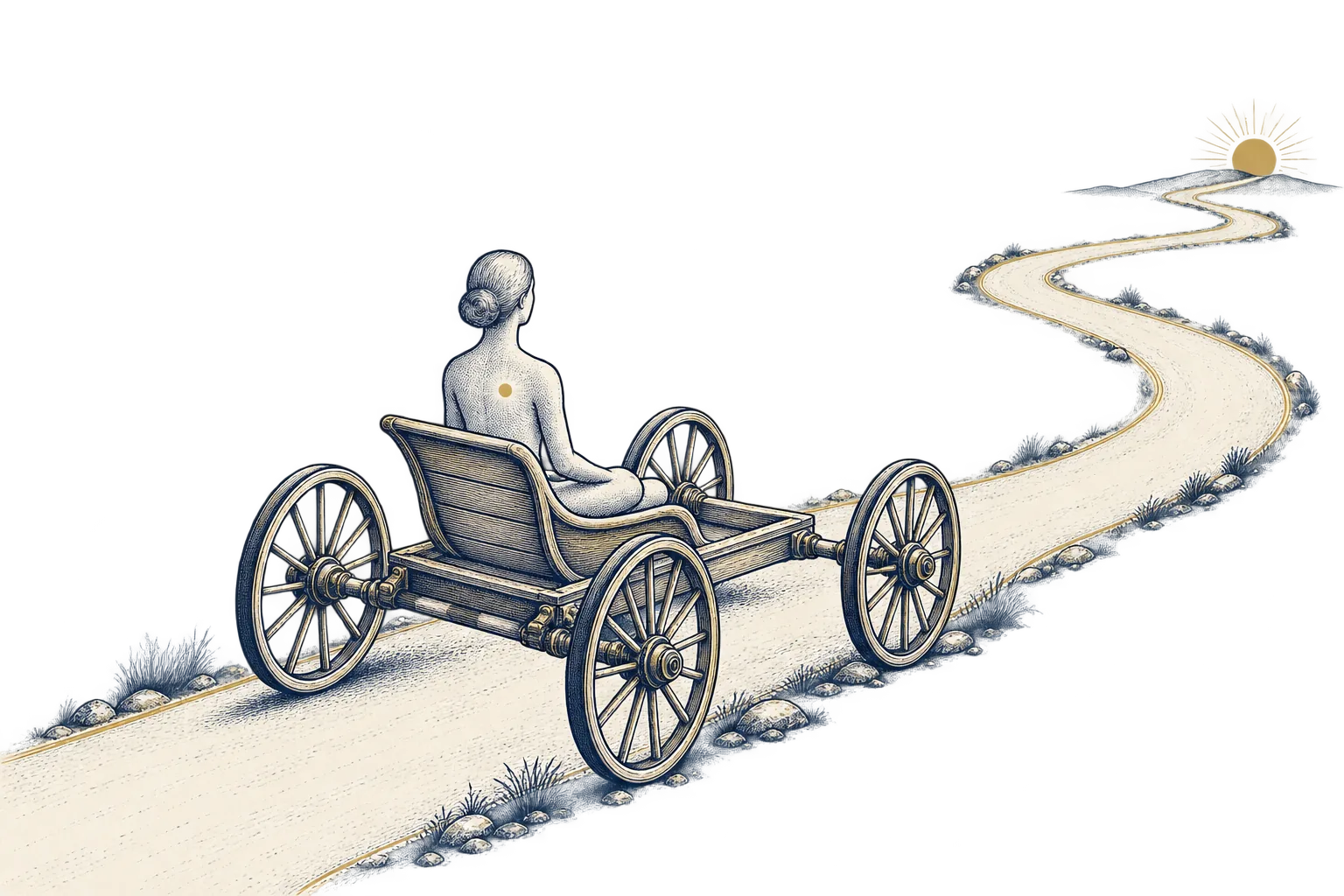
Welcome to Day 18
Yesterday we opened the Profession wheel through Karma Yoga. Today we turn to its ethical dimension. Read slowly in one sitting, and carry the day’s question with you.
The shape of today
- Opening — What my action sets in motionThe Journey of Life, and the question every action raises.
- The teaching — Dharma, Svadharma and Right LivelihoodThe Gita, Buddhism and Jainism on ethical responsibility.
- Value of the day — Samyak ĀjīvaEthical clarity, not ethical purity; EVA in the ethical dimension of work.
- Health segment — Ethical health of the Profession wheelThe long feedback loop, and the line you will not cross.
- Show notes — Expert resources (optional material)Two optional videos: Philip Zimbardo and Wendy Dean.
- Intentional activity — Ethical friction points at workFour quiet steps: notice, name it, ask, return.
- Scientific quadrant and closingWhy good people drift; Left Nostril Breathing and Ānāpānasati.
- A quiet place to read, and a pen for the reflection spaces.
- A phone or computer for the two optional expert videos (about 55 minutes).
- The Day 18 meditation audio (15 minutes).
Life can get busy. Take more than 21 days if you need to; there is no need to rush. If you cannot move to the next day of TLM Basic, continue practising the Value of the Day, Intentional Activity and Meditation from the last day you completed. When you are ready, resume the programme from where you left off.
What my action sets in motion
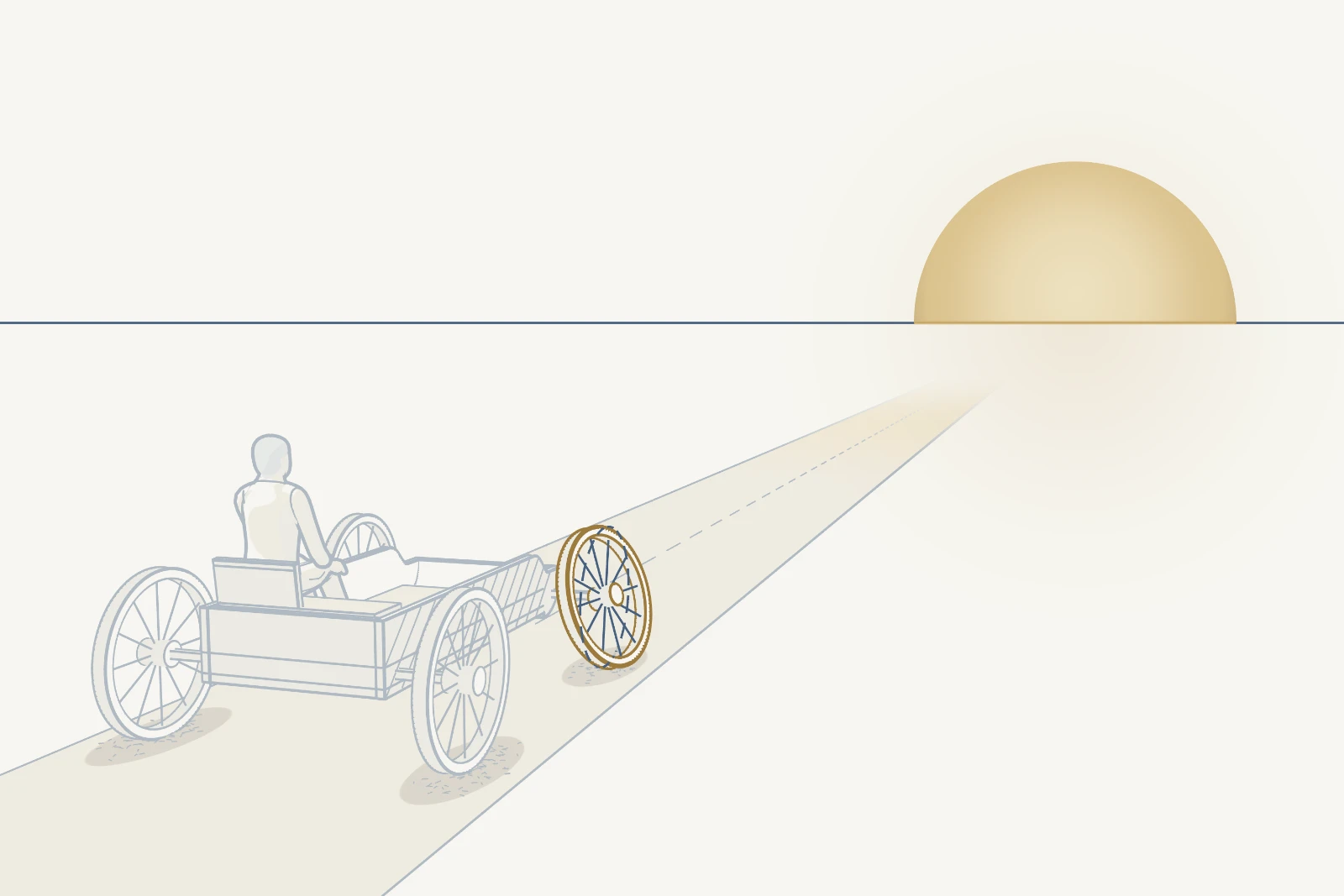
We are on Day 18 of TLM — Day 4 of Week 3.
We looked at how we act, how we relate to outcomes, and how we can remain fully engaged in our work without becoming the role. We saw Karma Yoga as a way of working with complete commitment while releasing our grip on the fruits of action.
But there is another question.
Because work is never only about the person who performs it. Every professional or work action affects someone else too. Every decision has consequences. Every role carries responsibilities.
And therefore, alongside Karma Yoga, we need another principle.
The quality of the action itself
Today, we add another dimension to that teaching: Dharma. If Karma Yoga addresses our inner relationship with action, Dharma asks us to consider the quality of the action itself — and its relationship with the larger order of life.
The Gita does not ask us merely to act. It asks us to act in accordance with Dharma. This also connects with Loka Saṅgraha — action that contributes to the welfare and harmony of the larger whole.
Our work, therefore, cannot be judged only by whether it produces success for us. We also have to ask: What does my action set in motion for others?
Svadharma
This brings us to another important Gita teaching: Svadharma. Svadharma is one’s own specific duty — the responsibility that arises from one’s role, circumstances, capacities and position.
The duty of a soldier is not identical to that of a doctor. The responsibility of a leader is not identical to that of a subordinate.
And professional life constantly presents us with Svadharma moments.
- A manager may be asked to sacrifice the wellbeing of a team for a target.
- An accountant may be pressured to approve something that is not right.
- A doctor may face pressure to put institutional interests ahead of the patient’s welfare.
In such moments, the challenge is not simply knowing what is right. It is having the inner clarity and courage to remain aligned with one’s responsibility when pressure pulls in another direction.
When we repeatedly abandon that alignment for convenience, fear or personal gain, something happens within us. We may continue to perform the role externally, but internally we begin to experience fragmentation.
Right Livelihood and non-harm
The Buddhist teaching of Samyak Ājīva — Right Livelihood asks us to examine not merely our intentions, but the consequences of the way we earn and practise our profession.
The question is not simply: “Am I a good person?” It is also:
This is important because professional harm is not always the result of one dramatic decision. It can emerge through a series of small compromises.
One compromise becomes easier to justify.
Then another.
And gradually, something that once disturbed us begins to feel normal.
Ahimsa and Pramāda
Jainism brings the principle of Ahimsa — non-harm into this conversation. And harm is not limited to physical harm. Our professional actions can cause psychological harm, economic harm, or even systemic harm.
Jain thought also gives us an important concept, discussed earlier in TLM, here: Pramāda — heedlessness or carelessness.
Ethical drift often does not begin with a conscious decision to do something wrong. It begins when we stop paying attention. We ignore a small discomfort. We rationalise a compromise. We tell ourselves that everyone does it. And slowly, our sensitivity to what is right and wrong begins to diminish.
This is why ethical awareness is itself a form of Inner Governance.
Although these traditions differ in their philosophical foundations, each offers a perspective on ethical responsibility and the consequences of action.
teaches us how to relate to action.
asks us to examine the ethical quality of action.
asks what that responsibility means for us in our particular role.
asks us to examine the larger consequences of our livelihood.
remind us to remain awake to harm and to the gradual drift that can make that harm invisible.
Across these traditions, ethical failure is rarely presented as a problem of knowledge. More often, it is a problem of awareness. We usually know more than we practise. The challenge is not learning new values. The challenge is remaining awake to them under pressure.
That brings us to today’s Value of the Day: Samyak Ājīva — Right Livelihood. And here, a principle we have already encountered earlier in TLM — EVA, Engaged Value Attachment — becomes particularly relevant. We will now see what it means to remain fully engaged in our profession while remaining anchored to the values by which we have chosen to live.
Samyak Ājīva
Samyak Ājīva refers to the way one earns, leads, decides, and exercises professional responsibility such that one’s work does not knowingly cause harm, corruption, or inner fragmentation.
It is not about being ideal. It is not about moral perfection or expecting clean choices in messy systems. It is about remaining ethically awake within real-world constraints.
And the distinction that matters most is this:
It does not ask you to refuse complexity or ambiguity. It does not ask you to quit your profession at the first ethical tension. It asks you to remain inwardly honest — not to numb the signals that ethical friction produces, and not to mistake rationalisation for wisdom.
And this is where a principle we have already encountered in TLM finds its most direct application to the Profession wheel:
EVA — Engaged Value Attachment
EVA is the capacity to remain fully engaged in professional action while remaining firmly attached to core values. So Samyak Ājīva is EVA in the ethical dimension of work.
It does not mean withdrawing from the system. It does not mean merely performing compliance. It means maintaining the inner thread of values under exactly the pressure that systems apply most forcefully.
Inner Governance
“The disciplined capacity to regulate attention, emotion and behaviour even under pressure — in alignment with personal values and institutional ethos to fulfil the envisaged goal.”
Engaged Non-Attachment
The trained capacity to be fully present in every role you play, fully engaged in every responsibility, and fully committed in every relationship — without being defined, driven or destabilised by any one of them.
Engaged Value Attachment
The capacity to remain fully engaged in professional action while remaining firmly attached to core values.
Do
- Acknowledge ethical friction when it arises rather than dismissing it.
- Stay attentive to who bears the cost of decisions.
- Remain personally accountable, even within large organisations.
- Allow discomfort to inform reflection, rather than denial.
Do not
- Normalise harm because it is widespread.
- Outsource responsibility entirely to hierarchy or policy.
- Silence ethical discomfort through rationalisation.
- Repeatedly act against conscience and call it professionalism.
Samyak Ājīva therefore does not demand a perfect professional world. It asks us to remain ethically awake within the world we actually inhabit.
Ethical health
Today, there is another dimension of professional health that is less visible — but potentially deeper. It is ethical health.
There is a form of professional damage that does not simply affect the nervous system. It can affect identity itself.
The person continues to function.
They continue to perform.
They continue to meet targets.
And yet, somewhere inside, they carry a quiet, unresolved damage for which they may have no language and no legitimate space to speak. They may gradually stop caring. Not because they are weak. Sometimes, it is because self-protection has taken over.
I have observed this repeatedly across my years in the Army and in other institutional environments.
And the ethical dimension of professional action becomes particularly visible in the military. When a decision is made under fire, under pressure, or under command authority, its consequences can be immediate and visible. A poor command decision may have a person standing in front of you — or lying on the ground because of it.
You cannot easily defer the consequence. You cannot easily rationalise it away. That visibility, in a strange way, is a protection. It makes the ethical cost of a decision difficult to deny.
In many professional settings, the feedback loop can be longer. The person affected by a financial decision may not be in the room, and the community affected by a policy may never be visible to the person who made it.
The consequences become diffuse. And that distance makes ethical drift easier.
Because when we do not see the harm, over time we may stop feeling that harm is even possible.
That is Pramāda. It is the gradual shrinkage of the moral world — the quiet collapse of the inner ethical life.
And this is why ethical health cannot be reduced to a compliance framework. Rules matter. Policies matter. But they cannot substitute for an inner ethical line.
The question that has protected me — and that I believe every professional needs to revisit — is very simple:
The line I will not cross.
The person who has answered that question honestly, and keeps that answer alive in awareness, is far more likely to maintain Samyak Ājīva under the full pressure of professional life.
Part 2 — Integration
The ethical health of the Profession wheel is not something we can address after professional success has been achieved. It is a condition of the inner stability that makes professional life sustainable at all.
And what the wisdom traditions have taught, the research increasingly confirms:
Repeated ethical compromise may affect how we see ourselves, how we relate to our work and how readily we recognise future ethical conflicts. This is why ethical health is not merely an abstract moral concern. It is part of Inner Governance.
Expert resources on the ethics of professional life and the science of moral injury are in the Show Notes that follow. Both deepen what we have explored today.
Two expert resources
The Psychology of Evil
Philip Zimbardo explores how ordinary people can commit ethical violations under systemic pressure — directly illustrating the mechanisms of Pramāda and ethical drift we have discussed today.
Burnout and Moral Injury in Medicine
Wendy Dean examines moral injury in high-responsibility professional settings, extending what we have explored about the ethical health of the Profession wheel.
Presented in a medical context, Wendy Dean’s discussion of moral injury offers a useful framework for considering how ethical conflict and institutional pressures may affect other high-responsibility professions. The circumstances and effects can differ across settings.
Ethical friction points at work
It is not about changing your behaviour, taking a moral stand, confronting someone, or making a decision. Its purpose is purely diagnostic. It trains ethical attentiveness — the capacity to notice when your work begins to feel inwardly misaligned.
In professional life, ethical stress rarely appears as clear wrongdoing. It appears as friction. Perhaps a quiet unease. A discomfort. The need to justify something. A sense of emotional dullness. Or even the thought: “I shouldn’t think too much about this.”
These signals are not guilt. They are information.
How to do it
- Step 1 — Notice. At some point today, notice one ordinary work-related moment where something feels ethically uncomfortable. Perhaps pressure is overriding reflection. A shortcut is becoming normalised. A responsibility is being quietly passed around: “This isn’t really my call.” Don’t choose the most dramatic situation. Choose something ordinary.
- Step 2 — Name it silently. Pause briefly and acknowledge inwardly: “Ethical friction is present.” Do not analyse it. Do not judge it. Do not justify it. Simply notice.
- Step 3 — Ask one question. Ask yourself quietly: “What is being compromised here?” It could be time. Truth. Fairness. Human impact. Or your own sense of integrity. You don’t have to answer completely. Simply let the question register.
- Step 4 — Return. Then return to your work exactly as it was.
No correction.
No moral action.
No rumination.
The exercise is diagnostic rather than prescriptive. Noticing ethical friction does not mean ignoring wrongdoing, abandoning accountability, or remaining in an unsafe situation.
The value of this exercise lies in seeing, not changing. Because awareness precedes healthy self-regulation. Today, seeing is sufficient.
Ethical clarity does not begin with action. It begins with noticing where action feels uneasy.
Why good people drift
The Scientific Quadrant explains contemplative practices through current scientific understanding of psychology, behavioural science and neuroscience. The mechanisms described indicate how these practices may influence attention, emotional regulation, behaviour and wellbeing. Scientific understanding continues to evolve, and these explanations are not guarantees of specific outcomes. Individual experiences may vary.
Today’s teachings focus on an important but often overlooked aspect of professional wellbeing: Ethical Health.
Most people assume that ethical failures occur because individuals deliberately choose to do the wrong thing. In reality, research in psychology and behavioural science suggests that many ethical failures occur gradually.
Small compromises become easier to justify.
Repeated behaviours begin to feel normal.
Actions that once created discomfort stop attracting attention. Over time, awareness fades.
This process is remarkably similar to what the Jain tradition calls Pramāda — carelessness, forgetfulness, or loss of awareness. The problem is often not lack of knowledge. The problem is loss of attention.
The brain’s ethical monitoring system
The brain contains several systems that help us recognise when something requires closer attention. One of the most important is the Anterior Cingulate Cortex (ACC).
The Anterior Cingulate Cortex (ACC) participates in monitoring conflict, errors and situations that require additional control. Ethical decisions involve broader interacting systems, including processes associated with emotional awareness, evaluation and self-regulation.
- That uneasy feeling before sending an email.
- The discomfort before withholding important information.
- The hesitation before compromising a principle.
These moments often involve the brain’s conflict-detection systems. The Insula contributes by helping us recognise internal emotional signals and feelings of discomfort. The Amygdala highlights emotionally significant situations and potential threats. The Prefrontal Cortex helps us pause, reflect and choose a response aligned with our values rather than reacting automatically.
The interaction of these processes may contribute to what we experience as a conscience or an inner warning signal.
Why ethical drift happens
The brain is highly adaptive. Repeated exposure to the same behaviour gradually reduces its emotional impact. Psychologists sometimes refer to this process as normalisation.
What initially feels uncomfortable begins to feel familiar. What feels familiar often stops attracting attention. This is why ethical drift can occur even in well-intentioned individuals.
Attention and self-regulation involve interacting brain networks. The Salience Network contributes to identifying information that deserves attention, while executive-control processes support reflection and the regulation of behaviour in relation to goals. These are simplified associations, not a complete account of ethical decision-making.
When important ethical signals are overlooked, repeatedly justified or ignored, they may become harder to recognise. Deliberate reflection can help us notice inconsistencies before they become established habits.
Why today’s practices matter
Today’s practices are intended to support ethical awareness from multiple directions.
may help settle physiological arousal and create space for reflection.
trains attention and non-reactive observation, which may help create space before responding.
reminds us that livelihood itself can become part of spiritual practice.
develops the ability to recognise ethical friction before rationalisation takes over.
Together, these practices help strengthen what might be called the mind’s ethical radar.
The Seven Stages of Inner Governance
Today’s lesson primarily belongs to Stage 5 — Purify the Mind. Purification involves recognising the subtle patterns that distort judgement, behaviour and motivation. Ethical drift is one such pattern. The moment we become aware of it, purification begins.
As awareness deepens, another possibility emerges. We begin to notice not only ethical choices, but also the thoughts, emotions and impulses that precede them. This marks the beginning of Stage 6 — Witness the Mind.
The ability to observe the impulse before acting upon it is one of the foundations of Inner Governance.
Scientific takeaway
Most ethical failures do not begin with bad intentions. They begin with reduced awareness.
Brain systems involved in conflict monitoring and self-regulation can help us recognise situations that call for reflection. However, ethical awareness is influenced by attention, context, emotion, habits and social pressures. Such signals can also weaken when compromises are repeatedly justified or ignored. Practices that cultivate awareness, reflection and compassion may help us notice ethical tensions and consider our responses more deliberately.
In this sense, ethical health is not merely a moral issue. It is also an attentional issue. The more awake we remain, the less likely we are to drift. And that is why awareness itself is one of the most important forms of protection.
- Samyak Ājīva is ethical clarity, not ethical purity: remaining awake within real-world constraints.
- Ethical failure is rarely a problem of knowledge. More often, it is a problem of awareness.
- When harm is distant and diffuse, drift becomes easier. Know the line you will not cross.
- Friction signals are not guilt; they are information. Noticing them is Samyak Ājīva in practice.
Engaged, and ethically awake
Yesterday, we explored how to be fully engaged in our professional role without becoming consumed by it. Today, we went one step deeper. We explored Samyak Ājīva — Right Livelihood, and the importance of remaining ethically awake even within complex systems. We saw how repeated ethical compromise can gradually lead to ethical drift, and how that can affect not only our work, but our inner life.
And today’s practice was deliberately simple:
Notice the friction.
Don’t immediately defend it.
Don’t rationalise it.
Don’t react.
Just see. Because ethical clarity begins with awareness.
So perhaps the question you carry from these two days is:
And now, in meditation, we will practise precisely that quality of awareness: settled, attentive, and non-reactive.
Meditation — Ānāpānasati
Guided audio — 15 minutesPress play on the meditation audio, sit comfortably, and simply practise.Let us begin.
Use the course meditation recording for the guided practice. The timer below is a quiet companion for practising on your own.