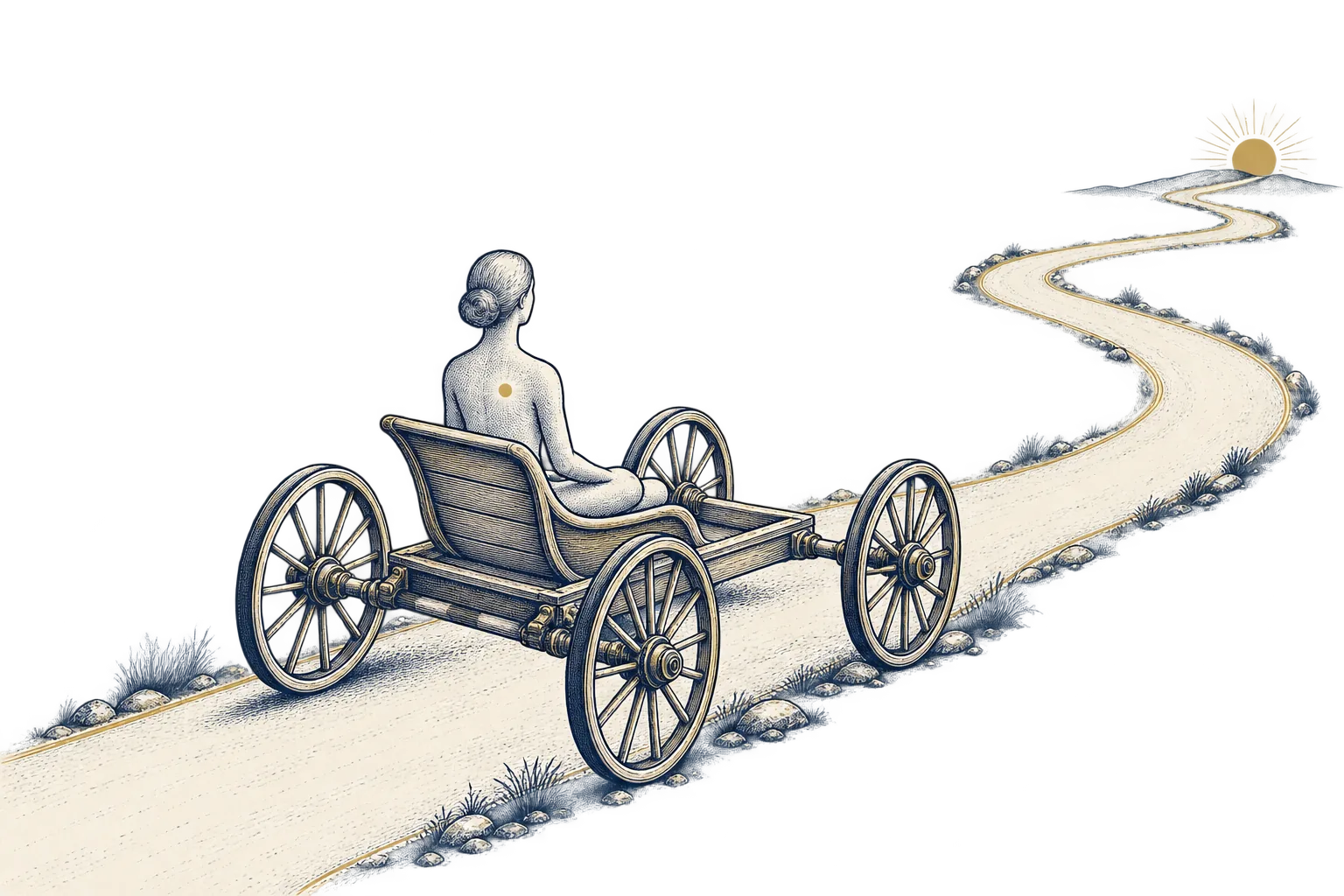
Welcome to Day 17
Today the Vehicle turns on its third wheel. Read the module slowly in one sitting, keep one ordinary moment of your working day for the Intentional Activity, and watch the two optional expert videos when it suits you.
The shape of today
- Opening — The third wheel: WorkThe Journey of Life, and what the Work wheel means in TLM.
- The teaching — Karma YogaThe Gita on work: Nishkāma Karma, Loka Saṅgraha and the archer.
- The teaching — Seva, and the Traveller who is not the roleSikh wisdom on work as service; Advaita Vedanta’s actor and the costumes.
- Value of the day — Maitri and KaruṇāLoving-kindness and compassion in working life.
- Health segment — Professional healthBurnout, demand and control, and lessons from four decades in the Indian Army.
- Expert resources (optional material) and Intentional activityTwo optional videos; Alignment vs strategy in one ordinary moment of work.
- Scientific quadrant and closingFrom purifying to witnessing; Left Nostril Breathing, Loving-Kindness Meditation.
- A quiet place to read, and a pen for the reflection spaces.
- Optional: a phone or computer for the two expert videos (about 55 minutes in all).
- The Day 17 meditation audio.
Life can get busy. Take more than 21 days if you need to; there is no need to rush. If you cannot move to the next day of TLM Basic, continue practising the Value of the Day, Intentional Activity and Meditation from the last day you completed. When you are ready, resume the programme from where you left off.
The third wheel: Work

We are on Day 17 of TLM — Day 3 of Week 3.
The first wheel — Relationships — asked us to bring Satya, truthfulness, into how we connect with others. The second wheel — Finances — asked us to examine whether our relationship with money is driven by clarity or by fear.
Today we turn to the third wheel: Work.
The surgeon operating.
The executive deciding.
The teacher teaching.
The entrepreneur building.
The student studying.
And equally — the homemaker running a household, raising children, sustaining the daily fabric of a family’s life.
All of these are the Work wheel. And all of them place the same demand on the Traveller:
Karma Yoga: work as the field of liberation
It is spoken on a battlefield — in the middle of duty, pressure, consequence, and the full weight of action. That setting is not accidental. It is the entire point.
Krishna’s teaching on Karma Yoga addresses a precise diagnosis:
Three inner movements create bondage in work
Demanding specific outcomes as the condition of peace.
Taking the success or failure of the work as the measure of one’s worth.
The mental rehearsal of failure that consumes the energy that the work itself requires.
Karma Yoga does not say
- Do not care about results.
It says
- Do not confuse effort with outcome.
Excellence remains your responsibility. Outcomes never become fully yours. Give the work everything. Then release the demand that life return a specific answer.
This is not resignation. It is the intelligence of a mind that has stopped fighting what it cannot control — and has therefore become fully available for what it can.
Two principles
Karma Yoga essentially teaches two principles.
Nishkāma Karma: acting without attachment to the fruits of action. Nishkāma Karma does not mean lack of ambition, lack of excellence or lack of effort. It means freedom from psychological dependence upon a particular outcome.
But the Gita takes the idea further. It introduces Loka Saṅgraha — action for a cause larger than yourself.
Loka Saṅgraha is work that is not ultimately centred on personal gain, personal recognition, or even the satisfaction of having served. It is action because the work needs to be done and because its doing contributes to something larger than oneself.
The centre of gravity shifts from “What will I get?” to “What am I here to contribute?”
Krishna points to himself as the example — one who has nothing to gain, and yet continues to act because His action sustains the order of the world.
Loka Saṅgraha offers a wider orientation for action: contributing to the welfare of the world. Our ability to embody this principle may deepen with practice, but we can begin expressing it in ordinary work today. And naming it here matters, because it shows where the Work wheel, when the Vehicle is running well, can ultimately lead.
Seva: work as service
Kirat Karni — earn honestly through your own effort — establishes the ethical foundation. Spiritual growth is not reserved for retreats, monasteries or meditation halls. It can unfold in the midst of ordinary work done in the right spirit.
Seva gives that effort its deepest meaning.
The homemaker who tends the household as Seva.
The teacher who teaches as Seva.
The professional who brings skill and care to their work as an offering rather than merely a transaction.
The work itself does not change. The inner relationship to it changes entirely. And that is the central insight of Karma Yoga as well.
The Traveller is not the role
The surgeon is not defined by the outcome of the surgery.
The executive is not defined by the quarterly result.
The homemaker is not defined by the smoothness of the household.
These are roles the Traveller occupies — instruments through which the Traveller acts — not identities that constitute who the Traveller is.
When this distinction is unclear, every professional setback becomes an existential threat. Every criticism of the work is experienced as a criticism of the self. Every success inflates, and every failure deflates, the same fragile constructed identity.
As we develop a clearer distinction between awareness and the roles we occupy, professional success and failure need not determine our entire sense of self. That is Engaged Non-Attachment (ENA) at work: fully present in the role, without becoming the role.
Engaged Non-Attachment (ENA)
“The trained capacity to be fully present in every role you play, fully engaged in every responsibility, and fully committed in every relationship—without being defined, driven or destabilised by any one of them.”
When work is freed from attachment to outcomes, rooted in contribution, and no longer confused with identity, a different quality of action becomes possible.
Maitri and Karuṇā
Why do these two values belong to the Work wheel?
Because Karma Yoga without Maitri becomes cold efficiency.
A person can act without attachment to outcomes, release the grip of expectation and identity-fusion, and still become indifferent to the people their work affects. That indifference is not liberation. It is another kind of bondage — one that isolates the Traveller from the relational ground in which all professional work is embedded. That is why TLM places the Relationships wheel before all others.
Patanjali names Maitri and Karuṇā among the attitudes that maintain inner steadiness in relation to others.
Friendliness, loving-kindness: the quality brought to colleagues and to those who are doing well.
Compassion: the quality brought to those who are struggling, whose work is failing, or who are simply not coping.
Together they provide the relational warmth that makes Karma Yoga liveable, rather than merely admirable.
Buddhism’s Metta Sutta teaches the same qualities as deliberate cultivation rather than as something we wait to feel.
May this person be at ease.
May this person be free from suffering.It is an intention repeatedly placed — trained into the mind through practice until it becomes increasingly natural. And today’s meditation will begin that practice directly.
In the Work wheel, Maitri and Karuṇā look like this:
- Bringing genuine goodwill to the people you work with, not as performance but as a quietly held intention;
- Responding to another person’s difficulty with care rather than judgment;
- Correcting without humiliation;
- Disagreeing without contempt;
- And leading without requiring that acknowledgment flow only in one direction.
Professional health
And like relational health and financial health, it has hard consequences when the wheel is neglected — physiological, measurable and serious.
Christina Maslach identified burnout as a three-dimensional syndrome: emotional exhaustion, cynicism, and reduced efficacy.
Robert Karasek’s work showed the importance of the relationship between demand and control — particularly when high demands are combined with low control and a chronic sense that one’s effort does not meaningfully connect with outcomes. When that combination persists, professional strain can affect sleep, stress physiology and cardiovascular health.
The third wheel, when it wobbles, sends the damage through the Vehicle.
My four decades in the Indian Army
Now I want to speak about the professional wheel from my own experiences. I spent nearly forty years in an institution that is, by any objective measure, one of the most demanding professions that exists: the Indian Army.
Think about what the military profession involves.
- A genuine threat to life and limb in certain postings.
- No defined working hours.
- Prolonged separation from family.
- A steep promotional pyramid, where many exceptionally capable officers will not reach the ranks their ability deserves.
- And compensation that, relative to comparable responsibility in civilian life, is modest.
- And to top it all, a relatively early retirement, even in the early 40s, when professionals in other fields are peaking.
Across my nearly four decades in the Indian Army, I saw how a strong sense of purpose, shared responsibility and service could help people sustain commitment through demanding circumstances. These experiences shaped my understanding of the relationship between work, meaning and inner resilience.
Why?
- Because the work is meaningful.
- Because it serves something genuinely larger than the individual.
- Because the community of shared purpose is real and felt.
And because the Karma Yoga that the Gita describes — complete engagement in action, release of the grip on outcome, work offered for Loka Saṅgraha, the welfare of something beyond oneself — is not merely philosophy in such an environment. It can become an operating culture.
This is the deeper lesson:
The same demands, the same hours, the same separation, the same uncertain outcomes — when carried in the context of genuine purpose, can be experienced very differently from identical demands carried in a context of meaninglessness.
The Profession wheel is therefore not maintained simply by reducing the demands placed upon it. It is maintained by ensuring that the inner relationship with the work remains: clear, purposeful, and free from compulsive outcome-attachment.
Karma Yoga is not ancient wisdom that modern professionals need merely to translate. It is a principle of wholehearted action under pressure that has appeared wherever people have sustained demanding work in service of something larger than themselves. The Army is simply one of its most visible demonstrations.
Expert resources
Together, these resources explore two of the central themes of today’s lesson: what causes professional burnout, and what makes work meaningful. They are optional Deep-Dive resources, not part of the core lesson.
Understanding Job Burnout
Creator of the Maslach Burnout Inventory. Leading researcher on occupational burnout.
Christina Maslach explains how burnout develops — exhaustion, cynicism and reduced efficacy.
Job Crafting and Creating Meaning
Leading researcher on job crafting, meaning, and calling at work.
Amy Wrzesniewski explores how people can create greater meaning in the work they already do, through their relationship with the work itself.
Alignment vs strategy in work
Conceptual grounding: Self-Determination Theory — Edward Deci and Richard Ryan. Level addressed: Subtle.
It is an opportunity to observe your inner relationship with work in one ordinary moment today.
- Notice one work action
At any point today, notice one work-related action.
Responding to a message.
Participating in a meeting.
Making or avoiding a commitment.
Giving feedback or withholding it.
A decision made in the course of the homemaker’s day.Choose something ordinary.
- Pause and ask
Pause briefly before or after the action. Ask yourself quietly:
Am I acting from clarity — from what I genuinely believe is right here?
Or:
Am I acting from strategy — from what will look best, avoid the most friction, or protect my image most effectively?
- Notice the inner effect
After the action, notice: Is there a sense of ease? Or subtle tightness, unease, or the need to justify?
Research on self-endorsed action suggests that actions arising from genuine values and intention are associated with greater engagement and less stress.
You are not trying to change the action today. You are trying to see what quality of motivation was present.
- Return to the day
Return to your work. Do not replay it. Do not correct it. One moment of seeing is sufficient.
This is Maitri directed inward — bringing the same quality of honest, non-judgmental attention to your own working life that you are being asked to bring to others.
Why purifying the mind changes the brain
The Scientific Quadrant explains contemplative practices through current scientific understanding of psychology, behavioural science and neuroscience. The mechanisms described indicate how these practices may influence attention, emotional regulation, behaviour and wellbeing. Scientific understanding continues to evolve, and these explanations are not guarantees of specific outcomes. Individual experiences may vary.
Over the past two weeks, the practices of TLM have progressively trained different capacities of the mind. You first learned to understand the mind and calm the mind. You then learned to train attention and focus, and gradually develop greater control over where attention is directed.
Today’s lesson primarily operates at the next two stages: Purify the Mind and Witness the Mind.
The practices of today — Karma Yoga, Kirat Karni, Maitri, Karuṇā, Left Nostril Breathing and Alignment over Strategy — work together to gradually weaken these patterns and strengthen healthier neural pathways.
What is happening in the brain?
Professional situations often trigger some of the strongest emotional reactions in daily life. Recognition, status, achievement, criticism, promotion, rejection and financial security can all activate ancient threat-detection systems in the brain.
The Amygdala rapidly evaluates situations for potential threat and significance. When highly activated, it can contribute to anxiety, defensiveness and impulsive reactions.
The Prefrontal Cortex, located behind the forehead, supports reflection, emotional regulation, decision-making and long-term thinking. Many of today’s practices are intended to exercise this capacity to pause, reflect and respond consciously rather than react automatically.
The Insula plays an important role in self-awareness and empathy. It helps us recognise internal emotional states and become more sensitive to the experiences of others.
The Temporoparietal Junction (TPJ) contributes to perspective-taking — the ability to understand that other people may think, feel and experience situations differently from ourselves.
Practices such as Maitri and Karuṇā invite repeated engagement of processes involved in empathy, connection and social understanding.
Brain networks strengthened by today’s practices
| Brain network | Strengthened through | Supports |
|---|---|---|
| Executive Control Network | Alignment over Strategy, Reflection, Karma Yoga | Self-regulation, conscious choice, wise action |
| Salience Network | Maitri, Karuṇā, Loving-Kindness Meditation | Recognising what is important in relationships and the present moment |
| Default Mode Network | Karma Yoga, Advaita Reflection, Witnessing Practices | Reduced ego-identification and excessive self-referential thinking |
These associations are simplified teaching models. Each network participates in multiple functions, and the practices described may involve interacting brain systems. The table does not imply that a particular practice selectively trains one network or guarantees a specific neural change.
Why motivation matters
Modern psychology suggests that wellbeing depends not only on what we do, but also on why we do it.
Two people may perform exactly the same action. One may act from contribution, service and meaning. Another may act from fear, approval-seeking or image management.
Externally, the behaviour may appear identical. Internally, the experience is often very different.
Research in motivational psychology, including Self-Determination Theory, links autonomous, self-endorsed motivation with wellbeing and effective functioning. The relationship is influenced by working conditions and whether people have adequate support, autonomy and resources.
This insight lies at the heart of Karma Yoga.
The role of Maitri and Karuṇā
The mind naturally tends to organise experience around itself:
- How am I doing?
- How do I appear?
- Am I appreciated?
- Am I succeeding?
Maitri and Karuṇā help shift attention beyond this narrow self-focus.
Research on loving-kindness and compassion practices suggests that they may support positive social emotions and feelings of connection. Findings vary across outcomes and study designs, and individual experiences differ.
In this way, compassion becomes more than a moral virtue. It becomes a practical tool for purifying the mind.
Scientific takeaway
Today’s practices are training more than professional effectiveness. They are training the quality of motivation.
- Karma Yoga helps purify attachment to outcomes.
- Maitri and Karuṇā help purify the way we relate to other people.
- Alignment over Strategy helps purify intention.
- Left Nostril Breathing helps create the internal conditions necessary for awareness.
At the same time, the Advaita reflection introduces a deeper possibility: if thoughts, emotions, motives and professional roles can be observed, then perhaps they are not the deepest truth of who we are.
This marks the transition from Stage 5, Purify the Mind, to Stage 6, Witness the Mind — an important step in the journey of Inner Governance.
Inner Governance
“The disciplined capacity to regulate attention, emotion and behaviour even under pressure — in alignment with personal values and institutional ethos to fulfil the envisaged goal.”
- Action does not bind; the relationship with the result of action does.
- Give the work everything, then release the demand for a particular result.
- Roles are worn: be fully present in the role without becoming the role.
- Maitri and Karuṇā keep Karma Yoga humane: correct without humiliation, disagree without contempt.
- Meaning does not remove difficulty; it transforms the relationship with difficulty.
We have opened the Work wheel today
But profession is such a significant part of our lives that there is another dimension we need to explore.
Tomorrow, we go deeper into Profession — into how work can become not merely something we do, but a field for excellence, purpose, and contribution.
Because the question is not only: How do I work without attachment? It is also:
Your meditation is ready. Today’s pranayama, Left Nostril Breathing, will settle the system.
Meditation — Loving-Kindness MeditationPress play on the meditation audio, sit comfortably, and simply practise.Loving-Kindness Meditation — introduced for the first time in TLM — will begin to train Maitri and Karuṇā, not merely as ideas, but as a lived inner orientation.
Use the course meditation recording for the guided practice. The timer below is a quiet companion for practising on your own.