
Welcome to Day 15
Relationships are mirrors. They can reveal patterns in our own minds that we may not otherwise notice. They also challenge us to understand the other person and the situation more clearly. They do not merely connect us to others; they reveal us to ourselves.
Week 3 begins today with the Vehicle and its first wheel. Read the module slowly in one sitting, watch the two expert talks (about half an hour) when convenient, and carry today’s experiment in non-escalation through the day.
The shape of today
- Opening — A new phase of the journeyThe Journey of Life, the four wheels, and where you stand in the Seven Stages of Inner Governance.
- The teaching — What makes a relationship healthySix wisdom traditions on how we see one another.
- Value of the day — SatyaTruthfulness in thought, speech and action; ENA and EVA.
- Health segment — Relational healthThe Harvard Study, Gottman’s Four Horsemen and the escalation loop.
- Expert insights (optional material)Two talks, about 30 minutes: a good life, and how healthy couples disagree.
- Intentional activity — Non-escalation in one relationshipA one-day experiment: do less, not more.
- Scientific quadrant and closingThe relational brain; relationships as mirrors; the meditation.
- A quiet place to read, and a pen for the reflection page.
- A phone or computer for the two expert talks (about 30 minutes).
- The Day 15 meditation audio (15 minutes).
Life can get busy. Take more than 21 days if you need to; there is no need to rush. If you cannot move to the next day of TLM Basic, continue practising the Value of the Day, Intentional Activity and Meditation from the last day you completed. When you are ready, resume the programme from where you left off.
A new phase of the journey
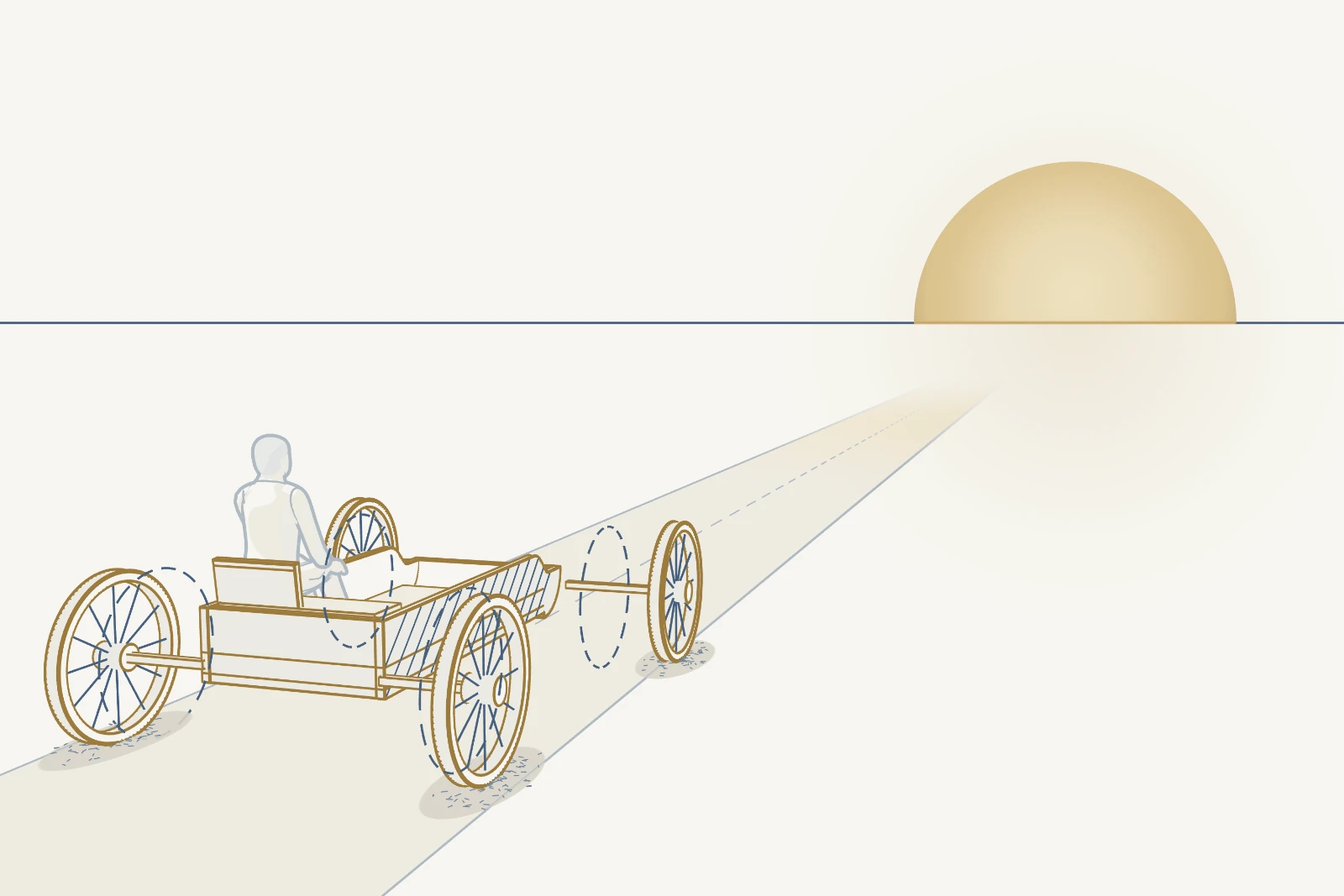
During Week 1, we oriented the Traveller — understanding who you truly are, beneath the roles and conditioning. During Week 2, we worked on the Instruments — the body and mind through which the Traveller experiences and acts in the world.
Now the journey enters a new phase. Week 3 turns to the Vehicle.
The Vehicle is the structure through which the Traveller, with steadied Instruments, moves toward the Goal along the Path. And the Vehicle runs on four wheels:
When any wheel is neglected, the Vehicle strains — regardless of how capable the Traveller, how smooth the path or how clear the Goal is. And this is where the inner work meets ordinary life.
We begin today with the first wheel: Relationships.
Where we stand
But before that, let’s look at the Seven Stages of Inner Governance, and where we stand.
During the first two weeks, we focused on understanding the Instrument, strengthening attention, building healthier habits, and cultivating the foundations of Inner Governance. We now enter the next phase of the journey.
Inner Governance
“The disciplined capacity to regulate attention, emotion and behaviour even under pressure — in alignment with personal values and institutional ethos to fulfil the envisaged goal.”
The focus of Week 3 is no longer merely training the mind in isolation. It is learning to observe the mind in action.
This corresponds to two important stages in the Seven Stages of Inner Governance: Purify the Mind and Witness the Mind.
And there is no better place to observe these processes than in our relationships. Relationships reveal our attachments, expectations, fears, reactions and unconscious patterns more quickly than almost any other domain of life. They therefore become one of the most powerful arenas for the practice of Inner Governance and Engaged Non-Attachment.
What makes a relationship healthy
The Bhagavad Gita offers a radical vision:
ईक्षते योगयुक्तात्मा सर्वत्र समदर्शनः ॥ ६.२९ ॥
sarva-bhūta-stham ātmānaṃ sarva-bhūtāni cātmani /
īkṣate yoga-yuktātmā sarvatra sama-darśanaḥ.
The person established in Yoga sees the Self abiding in all beings and all beings in the Self, seeing with equal vision everywhere.
(Bhagavad Gita 6.29)
Equal Vision in Relationships
True relationship begins with seeing the other person clearly—not merely through our expectations, judgments or emotional reactions.
It is not about performing kindness or suppressing emotions. It is about recognising the deeper humanity we share, while responding with awareness, discernment and compassion.
When we learn to see beyond our immediate reactions, we create the possibility of a more truthful and conscious relationship.
Buddhism expresses a related wisdom through Metta — loving-kindness. Metta is not simply a feeling. It is an intention cultivated through practice:
May this person be well.
May this person be free from suffering.
The practice gradually weakens the mind’s tendency to treat others as threats or instruments.
Patanjali, in the Yoga Sutra, gives us four precise attitudes for maintaining inner steadiness in relationships:
These are not sentimental instructions. They are ways of preventing the mind from being disturbed by the different kinds of people we inevitably encounter.
Jain philosophy adds another important dimension through Anekantavada — many-sidedness. No single perspective holds the whole truth.
In a relationship, this means recognising that another person’s experience can be real to them even when it differs from ours. That requires a certain humility — the willingness to hold our own certainties a little more lightly.
Sikh wisdom speaks of Sarbat da Bhala — the welfare of all. Not only the welfare of those who agree with us or are kind to us, but of all.
And Advaita Vedanta takes this understanding to its philosophical root. If the same consciousness underlies all apparent difference, then the separation that generates hostility is, at the deepest level, a misperception.
The Traveller who knows who they truly are — beyond body, role and conditioning — cannot easily sustain the quality of hostility that causes deep relational damage.
Different traditions. Different languages. But a remarkable convergence:
Satya
Satya is not simply about not lying. It means alignment with reality — in thought, speech and action. It means not distorting what you actually know to be true because of fear, convenience, image, or the desire to manage how others see you.
Why begin Week 3 with Satya?
Because relationships are particularly vulnerable to its absence.
Think about what happens when Satya disappears.
- We say we are fine when we are not.
- We agree when we disagree.
- We perform warmth we do not feel.
- We avoid naming what is actually happening.
Each small distortion creates a gap between what is real and what is being presented. Over time, that gap weakens the ground on which the relationship stands.
But Satya does not mean saying everything you think. It requires Viveka — discrimination.
Satya asks that what you do say arises from honest ground, rather than from performance.
So today
- Let your words arise from what you actually know to be true.
- Acknowledge what you are actually feeling before responding.
- Allow honest silence rather than dishonest reassurance.
But do not
- Use partial truths to manage how others see you.
- Agree outwardly while disagreeing inwardly.
- Use apparent honesty to wound.
- Mistake bluntness for Satya.
Satya, ENA and EVA
Satya is also foundational to the EVA principle — Engaged Value Attachment that we will develop later this week.
ENA allows us to be fully engaged in each wheel without being defined or destabilised by it.
EVA will ask us to remain fully engaged in our actions while remaining firmly attached to our core values.
Both require Satya at their base. A person who is not truthful with themselves cannot sustain genuine engagement or genuine values.
Relational health
The Harvard Study of Adult Development has followed people for more than eight decades. One of its clearest findings is that the quality of our relationships is among the strongest predictors of health, happiness and longevity. Warm, supportive relationships are associated with better physical and cognitive health. Chronic conflict and isolation take the body in the opposite direction.
How conflict is handled
John Gottman’s research adds an important insight. Conflict itself is not the problem. What matters is how conflict is handled.
Gottman identified four destructive patterns — the Four Horsemen: criticism, contempt, defensiveness and stonewalling.
What do these behaviours have in common? They communicate something to the other person’s nervous system: You are not safe here.
And when the nervous system registers threat, our capacity for empathy, nuance and proportional response begins to diminish. This is what Gottman describes as physiological flooding. At high levels of arousal, what comes out of us is increasingly driven by biology rather than by our values.
And this is why relationships can become physically exhausting. When conflict is occasional, the body can recover. But when a home or workplace becomes a persistent source of low-grade threat, the nervous system is repeatedly activated without fully recovering. Over time, that accumulated load matters.
Research on loneliness and social isolation has similarly shown that poor social connection is associated with a significantly higher risk of premature death.
So what produces relational health?
Not the absence of conflict. Conflict is inevitable.
What matters is whether we escalate or repair. Whether we become defensive or remain capable of listening. Whether we retaliate or create safety.
And this brings us to a very simple but powerful capacity:
Non-escalation
In the moment when the reaction fires, do less — not more.
You do not have to suppress the reaction. You do not have to resolve the conflict immediately. You simply have to not add fuel.
Small moments of non-escalation, repeated over time, can change the quality of a relationship. The first wheel of the Vehicle is maintained or damaged in the ordinary moments of every day. Not in crises.
Two expert talks
What makes a good life? Lessons from the longest study on happiness
This talk draws upon one of the longest and most respected longitudinal studies ever conducted — the Harvard Study of Adult Development — which has followed individuals and families for more than eighty years. Its findings reinforce a central message of today’s lesson: the quality of our relationships profoundly influences our health, wellbeing and life satisfaction.
Even Healthy Couples Fight —
the Difference Is How
This talk explores how relationships are strengthened or damaged in ordinary moments of disagreement, and why the capacity to repair and de-escalate matters more than the absence of conflict.
It covers how the pattern of conflict in the first three minutes predicts relationship outcomes — directly reinforcing the Four Horsemen and repair capacity content in today’s health segment.
Together, these resources provide a scientific foundation for the ideas explored in today’s module.
Non-escalation in one relationship
How to do it
Choose one relationship that frequently activates you, or carries a mild recurring irritation. Do not choose the most painful relationship in your life. Choose an ordinary, real relationship — someone you live with, work alongside, or regularly encounter.
Then, as you move through the day, watch for the moment of activation. Notice when irritation arises. Notice when judgment appears. Notice the urge to correct, defend or withdraw.
You do not need to suppress any of this. Simply notice it. That noticing is already Satya. You are seeing what is actually happening.
Then practise one thing: Do not escalate.
Non-escalation does not mean accepting mistreatment, abandoning your boundaries or remaining in an unsafe situation. It means choosing not to add unnecessary fuel to an ordinary moment of tension.
Do not raise your voice. Do not sharpen your words. Do not add one more critical thought. Do not send the extra message, make the extra comment, or deliver the final remark.
You are not required to agree. You are not required to explain. You are not required to resolve anything in that moment. Simply do not add fuel.
And when the moment has passed, let it pass. Do not analyse it. Do not congratulate yourself. Do not criticise yourself if you were unable to do it. This is practice, not performance.
If you remember to do this even once today, that is sufficient.
A small moment of non-escalation may seem insignificant.
Patterns gradually become character.
And character shapes relationships.
This is how Inner Governance begins to express itself in daily life.
Why relationships are powerful training grounds for the mind
The Scientific Quadrant explains contemplative practices through current scientific understanding of psychology, behavioural science and neuroscience. The mechanisms described indicate how these practices may influence attention, emotional regulation, behaviour and wellbeing. Scientific understanding continues to evolve, and these explanations are not guarantees of specific outcomes. Individual experiences may vary.
A difficult conversation, a critical comment, a misunderstanding, or even an unexpected silence from someone we care about can trigger strong emotional reactions within seconds.
From a neuroscience perspective, this is not a sign of weakness. It is part of how the human brain evolved. The brain continuously evaluates social interactions because, throughout human history, relationships have been closely linked to survival, belonging and security.
Social interactions can carry particular emotional significance because they engage processes associated with belonging, safety, memory and personal relevance.
What happens when we are triggered?
When a relationship challenge occurs, the brain often reacts before conscious reasoning fully engages.
The amygdala and other interconnected brain systems participate in evaluating emotionally significant events. Memories of similar experiences may also shape how the present situation is interpreted.
This is why reactions can sometimes feel automatic. We are not merely responding to the present moment. We are also responding to accumulated emotional patterns from the past.
The practical power of the pause
When we notice an emotional reaction as it is occurring, we may gain an opportunity to respond more deliberately. Awareness does not remove the reaction, but it can help create space between impulse and action.
The salience network may help us recognise what is happening in the present moment. The prefrontal cortex may become more involved in regulating impulses, evaluating consequences and guiding behaviour.
Instead of reacting automatically, we gain the possibility of responding consciously. This may be part of the neurological basis of the pause that today’s practice explores.
Satya and the neuroscience of self-awareness
Today’s value, Satya, is often understood as truthfulness in speech. Yet its deeper dimension is truthfulness in observation.
This includes seeing our own irritation, expectations, attachments, fears and emotional patterns without denial or distortion.
Research suggests that some mindfulness practices may support emotional regulation and psychological flexibility. Outcomes vary with the practice, the individual and the study. In practical terms, Satya begins when we honestly acknowledge what is happening within us.
Relationships as mirrors
Week 3 primarily focuses on two stages of Inner Governance: Purify the Mind and Witness the Mind. Relationships naturally support both.
They reveal attachments that require purification. They reveal reactions that require understanding. They reveal patterns that require transformation. And they provide opportunities to witness these processes in real time.
From the perspective of TLM, this is why relationships are such powerful arenas for Inner Governance. They do not merely connect us to others. They reveal the condition of our own mind.
Key takeaway
Every moment of non-escalation is more than a social skill. It is an act of training the mind.
Each time you notice a reaction without immediately acting upon it, you strengthen the capacity to witness. Each time you choose a conscious response over an automatic reaction, you strengthen Inner Governance.
And each time you bring Satya to your inner experience, relationships become not merely interactions with others, but opportunities for growth.
- Week 3 turns to the Vehicle, and its first wheel is Relationships.
- Satya is alignment with reality, guided by Viveka; it is never bluntness.
- Conflict is inevitable; what matters is whether we escalate or repair.
- When the reaction fires, do less, not more: awareness creates options.
- Relationships can reveal patterns that we may need to understand, work through and change.
Week 3 has begun
Relationships are not peripheral to the inner life. They are the terrain in which the inner life is tested most immediately and most honestly. What you are building in this programme — Engaged Non-Attachment, Inner Governance, the capacity to be fully present without being consumed — will first be confirmed or challenged in your relationships. Not in solitude. In the ordinary moments with the people who are closest to you.
Satya is your opening value this week for a reason. Begin there. With what is actually true. Everything else follows from that.

Notice the moment of activation.
Do less, not more.
Do not add fuel.
Tomorrow, we take the same inner governance into another powerful domain of life — our relationship with money.
Meditation — Ānāpānasati (10 minutes)Press play on the meditation audio, sit comfortably, and simply practise.Your meditation is ready. Move now from understanding into experience. Allow what has been understood today to move from the level of thought into something quieter and more solid.
Use the course meditation recording for the guided practice. The timer below is a quiet companion for practising on your own.