
Welcome to Day 1
You watched the introductory video, reflected on it, and chose to begin this journey. That itself is an important step. This module is meant to be read slowly, in one sitting if you can, and then carried into the rest of your day. It moves through six segments, each with its own character, designed to work together as a single training system. Take them in order. The whole of Day 1, including the audio at the end, takes about thirty minutes.
The shape of today
- Opening — The journey of life and the TravellerThe map that guides the whole course, and the central enquiry of Day One.
- Spiritual — Two lenses on the same truthAdvaita Vedanta asks who is observing; Buddhism shows how suffering is made.
- Philosophical — Value of the day: VivekaDiscernment, or clear seeing — three steps to practise through the day.
- Intentional activity — Sensory Awareness PracticeFive minutes with a small object in your hand — notice, then write.
- Scientific quadrant — Stage 1: Understand the mindThe Seven Stages of Inner Governance and the brain systems engaged today.
- Closing — From understanding to experienceFifteen minutes of audio: Yogic Breathing, then Mantra Meditation.
- A quiet place where you can sit undisturbed.
- A small object that fits in your hand—a raisin, a nut, a pebble, or a coin—for the Sensory Awareness Practice.
- A pen — this module has spaces to write in — and the Day 1 audio for the end.
Life can get busy. Take more than 21 days if you need to; there is no need to rush. If you cannot move to the next day of TLM Basic, continue practising the Value of the Day, Intentional Activity and Meditation from the last day you completed. When you are ready, resume the programme from where you left off.
The journey of life and the Traveller
Every human life is a journey with four essential elements: the Goal, the Path, the Vehicle, and the Traveller, with his instruments.
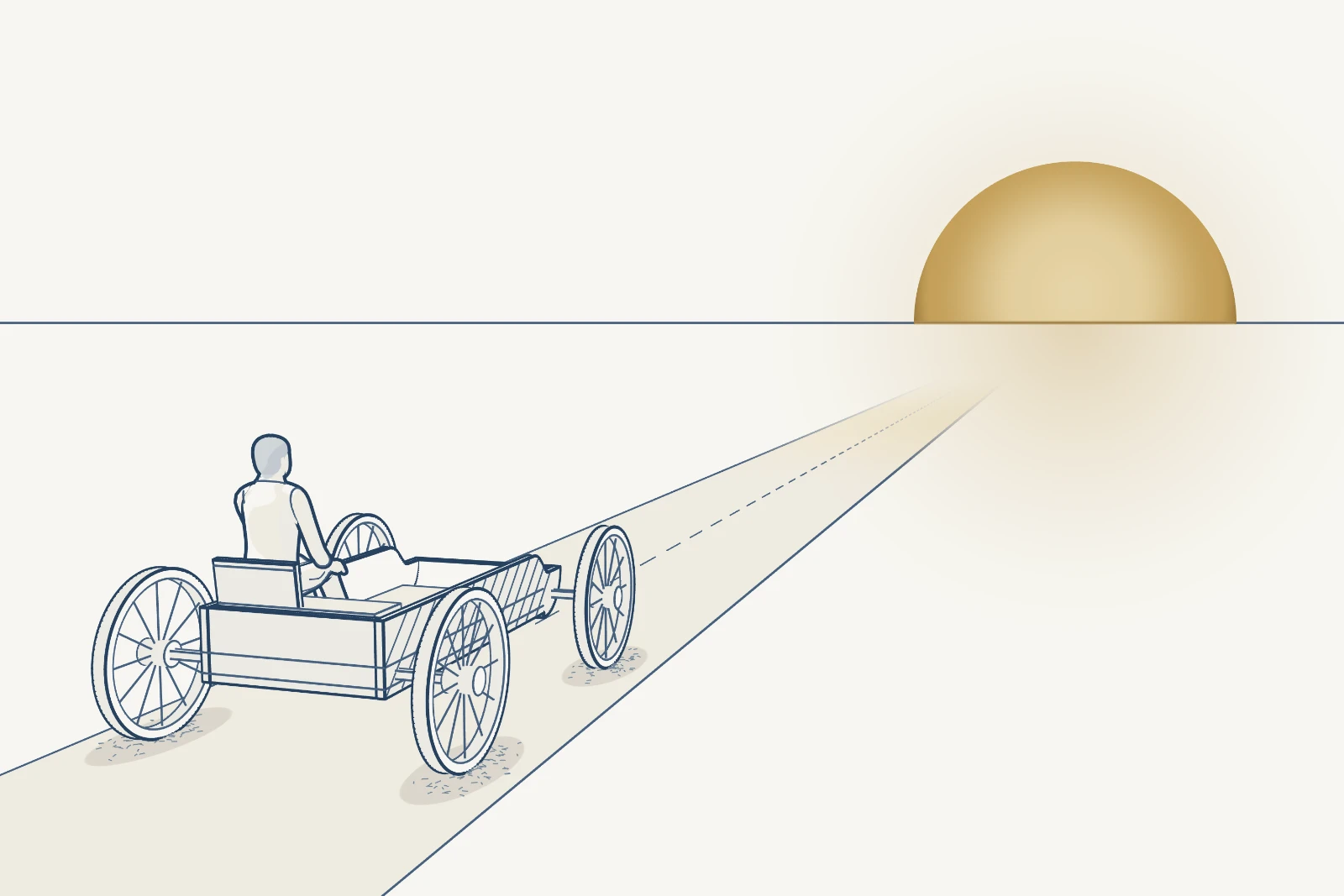
The Goal is what we are ultimately seeking—not merely success or wealth, but lasting peace, fulfilment and inner freedom.
The Path is how we live each day in pursuit of that Goal.
The 4-wheeled Vehicle is the life we travel in—our relationships, our values, our work and finances.
The Wheel of Life Reflection — your baseline
Score the four domains used throughout TLM Basic—Relationships, Profession and Work, Finances, and Values and Ethics—from 1 to 10, and write each score in its box. These are your baseline scores; record them to compare with later assessments.
The same assessment is repeated on Day 6 (end of Week 1), Day 14 (end of Week 2) and Day 21 (end of TLM Basic), so that you can observe changes over time. Scores need not rise: an unchanged or lower score is also useful information for reflection.
Your Wheel of Life
Record your scores from 1 to 10. Your entries are saved in this browser and gathered in your notebook.
But today, we begin with the most important element of all—the Traveller.
Most of us believe we are our body, our thoughts, our emotions, our roles and the story we tell ourselves about our lives; in short, we conflate ourselves with our body-mind complex. But all of these keep changing.
The body changes. Thoughts come and go. Emotions rise and fall. And that is why TLM treats these as the Instruments through which the Traveller transacts his business of life.
But who is the Traveller? The one aware of all these changes.
That is the central enquiry of Day One.
Because if the Traveller does not know who they truly are, the entire journey—even with the right Goal, the right Path and the finest Vehicle—remains subtly misdirected.
In the pages that follow, we will explore this question through two great wisdom traditions—Advaita Vedanta and Buddhism. Together, they help us understand not only who we truly are, but also how suffering is created—and how freedom becomes possible.
The enquiry into the observer
If I can observe something, it cannot be who I truly am. The observer cannot be the observed.
Right now, notice your own experience. You can observe your body. You can observe your thoughts. You can observe your emotions. You can even observe the story you carry about yourself—your successes, failures, roles and identities.
All of these keep changing. Yet something within you has remained constant from your earliest memory until this very moment. It has silently witnessed every thought, every emotion and every experience.
Vedanta calls this the Witness—pure awareness. Not another thought, emotion or identity, but that in whose presence all of them arise and pass away. To use a metaphor, you are the screen on which the movie of life plays.
Vedanta does not ask you to believe this. It simply invites you to enquire.
How suffering is manufactured
The Theravada tradition explains that every experience passes through a remarkably precise chain. Imagine someone criticises you.
- First, there is the raw event. Words are heard. At this stage, there is no suffering.
- Almost instantly, the mind labels the event. Is this praise or insult? Threat or appreciation? That label is shaped not by the event itself, but by your past experiences and conditioning. The same words can affect two people very differently.
- The moment that label is applied, the body responds. A sensation arises—perhaps tightness in the chest, warmth, or discomfort.
- Then, almost automatically, comes the reaction. We resist what feels unpleasant and cling to what feels pleasant. Every such reaction strengthens our old conditioning and makes the same pattern more likely in the future.
The remarkable thing is that this entire process happens in milliseconds, creating the illusion that “I am angry” or “I am hurt.” But what we call the “self” is often this rapidly unfolding process rather than a permanent entity.
Here lies the practical wisdom of Buddhism. Between the body sensation and the automatic reaction lies a tiny but trainable gap. Meditation gradually widens that gap. In that space, reaction gives way to response, conditioning gives way to choice, and suffering begins to lose its grip.
In short, the first arrow of the circumstances may still hit, but we won’t make it worse by the self-inflicted second arrow.
Two lenses on the same truth
Together, they help us understand not only who we truly are, but also how unnecessary suffering is created—and how it can gradually come to an end.
These two teachings are not contradictory. They are two lenses on the same truth. Vedanta asks who is observing. Buddhism shows what is being observed—and how suffering is manufactured in the observing. Together they give you both the destination and the map of the terrain.
It is worth remembering that these two traditions approach the enquiry differently. Advaita Vedanta points towards an underlying awareness as the Self, while Buddhist teaching examines experience without positing a permanent, unchanging self in the same way. We bring them together here not to erase this distinction, but to draw upon the insights each offers into our experience, our conditioning and the possibility of freedom from suffering.
The gap where freedom becomes possible lies between the body sensation and the automatic reaction. That gap is very small right now. But it can be trained. It is trainable. And that training is precisely what meditation does—which is why it sits at the centre of this programme, and why it is a central tool for working across all three levels of the mind, that we spoke about in the introduction video, simultaneously.
Viveka
Throughout the day, your mind continuously interprets every situation through the lens of your past experiences, beliefs and conditioning. We often mistake those interpretations for reality. Viveka is the ability to recognise that difference—to see the label as a label, rather than as the truth.
Viveka does not stop thoughts from arising. It does not suppress emotions or analyse every situation. It simply creates a small pause in which awareness comes before reaction.
Today, practise Viveka in three simple steps
- Whenever something triggers a reaction, pause. Just one conscious breath.
- Then ask yourself: Am I responding to what actually happened, or to the meaning my conditioned mind has attached to it?
- Finally, choose your response from that place of greater clarity rather than from your first impulse.
Do not expect perfection. If you practise this just once today, you have begun training the mind. Each such moment widens the gap between stimulus and response. That small gap is where Inner Governance begins.
Inner Governance
“The disciplined capacity to regulate attention, emotion and behaviour even under pressure — in alignment with personal values and institutional ethos to fulfil the envisaged goal.”
Inner Governance is not a trait. It is a trainable skill. Inner Governance is the key to Engaged Non-Attachment.
Do
- Pause before reacting.
- Notice the label your mind has applied.
- Respond from clarity rather than habit.
Do not
- Suppress your emotions.
- Judge yourself for reacting.
- Assume your first interpretation is always the truth.
Viveka is like a lamp. It does not change the path—it simply allows you to see it clearly. And every journey begins by seeing clearly.
Sensory Awareness Practice
Take a small object that fits comfortably in your hand—a raisin, a nut, a pebble, or even a coin. Spend about five minutes with it.
The purpose is not relaxation. The purpose is to observe your mind in action and practise Viveka—clear seeing. You will be experiencing the chain from the Buddhist teaching at a pace slow enough to observe it. After each movement, write a line or two of what you noticed.
Look
Begin by looking at the object as if you are seeing it for the very first time. Notice its shape, colour and texture. Whenever the mind immediately says, “I know this,” simply notice that tendency to label, and gently return to observing.
Touch
Now close your eyes and explore the object through touch. Notice the sensations in your fingertips. Observe how quickly the mind begins to describe, compare or judge what you are feeling. Simply notice the process without getting carried away by it.
Taste
If the object is edible, place it in your mouth slowly. Notice the first taste, the sensations, and any impulse to reach for more. Observe everything with curiosity, without trying to change anything.
Reflect
When you finish, spend a minute reflecting:
Every time you notice that difference, you strengthen the pause between experience and reaction. And that pause is where Inner Governance begins, ultimately leading to the quality of Engaged Non-Attachment (ENA), a key to Human Flourishing.
Engaged Non-Attachment (ENA)
ENA is
- Full presence in every role
- Action without egoic ownership
- Stability under pressure
- Giving fully; clinging to nothing
- Withdrawal from ego, not from duty
ENA is not
- Reduced involvement
- Emotional distancing
- Lowering of standards
- Indifference to outcomes
- Withdrawal from responsibility
Stage 1: Understand the mind
The Scientific Quadrant explains contemplative practices through current scientific understanding of psychology, behavioural science and neuroscience. The mechanisms described indicate how these practices may influence attention, emotional regulation, behaviour and wellbeing. Scientific understanding continues to evolve, and these explanations are not guarantees of specific outcomes. Individual experiences may vary.
The science behind today’s practice
Today’s lesson introduced a simple but powerful shift: Instead of reacting automatically, learn to notice, pause, and choose. This idea appeared in different forms throughout today’s practices:
- Observing the body-mind rather than becoming lost in it.
- Practising Viveka before reacting.
- Returning attention through sensory awareness.
- Stabilising the mind through breathing and meditation.
Although these practices come from different traditions, modern neuroscience suggests that they train many of the same brain systems.
What are we training today?
At its core, Day 1 trains a single capacity:
This capacity forms the foundation of what TLM calls Inner Governance. The more often you practise this sequence, the easier it becomes to respond consciously rather than react automatically.
Brain systems engaged today
Default Mode Network (DMN). The DMN is active when the mind drifts into memories, worries, fantasies, judgements, and repetitive self-talk.
Attention Networks. These networks help you deliberately place and sustain attention in the present moment.
Executive Control Network. This network supports self-regulation, decision-making, and the ability to pause before acting.
How today’s practices train the brain
| Practice | Brain system trained | Likely result |
|---|---|---|
| Observer reflection | Default Mode Network | Greater awareness of thoughts and mental habits |
| Viveka (pause and discern) | Executive Control Network | Reduced impulsive reactions |
| Sensory awareness | Attention Networks | Improved focus and presence |
| Yogic Breathing and Mantra Meditation | Attention and regulation systems | Greater calm and emotional balance |
Effects on brain, body and behaviour
| Level | What changes through practice | What you may notice in daily life |
|---|---|---|
| Brain | Stronger attention, greater self-awareness, improved self-regulation | Easier to notice thoughts, emotions and impulses before reacting |
| Body | Calmer breathing, reduced stress activation, better nervous-system balance | Greater physical calm, less tension, quicker recovery from stress |
| Behaviour | More intentional responses, fewer automatic reactions, better emotional regulation | Improved decision-making, greater patience, and more value-based action |
Why repetition matters
Every time you notice, pause, and return attention, you strengthen the neural pathways associated with awareness and self-regulation. This process, known as neuroplasticity, gradually transforms momentary acts of awareness into enduring habits of mind.
Today’s practices are not trying to stop thoughts. They are training your ability to notice what is happening within you without immediately being carried away by it. Each time you notice, pause, and choose, you strengthen the neural foundations of Inner Governance.
From understanding to experience
You have seen that much of our experience is shaped not only by what happens, but by how the mind interprets it. And you have been introduced to your first tool—Viveka, the ability to pause, observe, and respond with greater clarity.
Now it is time to move from understanding to experience.
Meditation — Mantra Meditation
Guided audio — 15 minutesPress play on the meditation audio, sit comfortably, and simply practise.The insights of today are not meant merely to be understood—they are meant to be experienced through Yogic Breathing and Mantra Meditation.
Use the course meditation recording for the guided practice. The timer below is a quiet companion for practising on your own.
Notes for the Traveller
- Life is a journey with a Goal, a Path, a Vehicle and a Traveller who uses instruments. You are not the body-mind complex; you are the awareness that is aware of it.
- The observer cannot be the observed. You are the screen, not the movie.
- Suffering is manufactured in a chain—raw event, label, sensation, reaction—and the second arrow is the one we add ourselves. Between sensation and reaction lies a tiny, trainable gap.
- Viveka works inside that gap: pause for one breath, ask what actually happened and what the mind added, then choose your response.
- Day 1 trains one capacity—notice, pause, choose—the foundation of Inner Governance, and the beginning of Engaged Non-Attachment.